A chemical cloud or cancerous growth
XXCongealed in space and sealed in a vacuum
XXThen cast in a polymer and painted blue
Served both for body and the monstrous head
XXIn which a sickly smile, lipstick-yellow,
XXWas outlined with a synthetic sunscreen.
If it had eyes, they were hidden behind
XXThe glasses of a ’50s beauty-queen
XXWho died long ago on Coney Island,
Pink as candy-floss in the melting sun.
XXIts vestigial fingers long since useless,
XXThe flapping flippers of a beached turtle
Clasped, like the hands of a dyspraxic child,
XXA beach towel moulded in red plasticine.
XXBeneath were a pair of legless feet
Encased in cowboy boots in matching pink,
XXThe high heels and pointed toes of which
XXShined with surf of a salivating sea.
And from the pedestal on which it stood
XXIn the plastic sand of its holiday
XXFour letters dipped in a metallic blue
Rose like razorblades from the yellow disc
XXOn which the printed nickname of ‘Vee’
XXAnnounced the monster of our century
With the title, in English and Chinese:
XX‘Visa Chief Experience Officer’.
XXA translator app of corporate cant
Explained the task with this job description
XXWas to ‘humanise’ digital payments
XXChiefly by overseeing whatever
Experience I must borrow to purchase
XXWith the authority of a creditor
XXConferred on it by my credulity.
For on this belief has been conjured a realm
XXAbove the world of free experience
XXCompelling us both to follow its lead.
And so it led me, and I followed it
XXTo explore its domain in broad daylight
XXAnd set down, from memory, what I saw.
Around the corner, a crowd had gathered
XXTo stare at something I pushed through to see:
XXA kitten! — wrapped in a white bandage
From its tail to its neck, like those with which
XXThe Chinese swaddle their new-born children
XXOr the Egyptians their mummified dead.
And although no more than a few days old,
XXIn the wide blue eyes of its tiny head
XXI saw, as I approached as in a nightmare,
That terror had long overtaken fear
XXWith a state of shock at its predicament,
XXTo my Western eyes most terrifying.
Defenceless amid the stampede of shopping
XXAnd deprived of every means of escape;
XXBalanced upright, instead, on its bandaged feet
Like a China doll left on the pavement;
XXExposed to the pity of the street
XXAnd the gaze of the smartphone screens through which
A flutter of girls — who cooed like mothers
XXOver this torture — captured the horror
XXIn a murmuration of digital eyes.
As I kneeled down to unpeel the binding
XXWith which this most feral of animals
XXHad been domesticated to a furry toy,
The owner, one of a gang of street boys,
XXSnatched his living doll from my reaching hands
XXAnd vanished into the consuming crowd,
Pursued by my useless protestations
XXIn a language he didn’t understand
XXAnd a sentiment he did not recognise:
‘You cannot do that to a living creature!’
XXHe left me on the edge of violence,
XXPinned by the weight of the consequences
In which I heard, as I pondered their meaning,
XXSpoken in Chinese without translation
XXThe foreign welcome: ‘Ni hao, waiguoren’.
Like the other boys — like the girls confused
XXBy my failed attempt at intervention —
XXHe had, hanging from a backpack branded
With the logo of some Western fashion,
XXOne of the maniacally grinning monsters
XXThat every urbane Chinese person —
From the young women who dress like schoolgirls
XXIn short pleated skirts and knee-high socks
XXTo the young men who so resemble them —
Has tied to their bag with the label intact
XXOr carries in a case specially inlaid
XXWith a transparent plastic window
The better to display their addiction.
XXNot real, these toys, not a breathing thing,
XXBut the object of a breathless pursuit
Through the shopping malls of their concrete cities
XXWhere every Instagram spot is painted
XXWith the cats they groom in pet grooming spas,
Their nails painted pink like the girls who pet them
XXAs if they were the children they do not have
XXAnd will never swaddle in a blanket.
Indifferent to what difference is, this
XXDying generation, when the image
XXAnd the real are close as life and death;
The boys indistinguishable from the girls
XXExcept by their clothes and anatomy;
XXAnd the screens with which they communicate
Divide them from themselves and each other;
XXAnd the values handed from parent to child
XXAre discarded in the nearest gutter;
And the past is rewritten every day
XXIn the perpetual now of the present;
XXAnd their future is a business plan
Deferred to the profits of tomorrow;
XXAnd culture has become a mural wall
XXAdvertising the soul’s highest bidder.
‘Here’, said the monster, ‘is my dominion!’
XXIt pointed with an ominous gesture:
XX‘How like you these sighs and lamentations?’
I turned away, and once again I felt —
XXAnd feel still — the uncrossable distance
XXBetween me and the land of my exile,
Which is not alone this alien place
XXBut the approaching country of old age
XXAnd that land from which no exile returns,
Eternity of death between the stars.
— Shanghai and Hong Kong, April-May 2026
• • • • •
My model for the verse in this poem was my concurrent reading of Allen Mandelbaum’s 1980 translation of Dante’s Inferno, mediated through the Dante homage in T. S. Eliot’s Little Gidding (1942). Like both, I have adopted Dante’s terza rima without the rhymes. But while the monsters and tortures of the Medieval imagination were shown to Dante on his journey through Hell, and those of the Modern imagination were hallucinated by Eliot in the waning dusk of a night during the London Blitz, in China’s cities the monsters of our own time appear to the traveller in broad daylight. ‘Monster’ comes from the Latin monstrum, meaning a ‘divine omen’ or ‘portent’, and is derived from monere, to ‘warn, remind or advise’, specifically of a violation of the natural order of things.
Labubu is a line of stuffed toys created by the Hong Kong illustrator, Kasing Lung. Variations of a furry monster with sharp teeth and large ears said to be drawn from Nordic folklore, the toys are produced and sold exclusively by the Beijing-headquartered Chinese retailer, Pop Mart, which releases them in sealed ‘blind box’ packaging that conceals the specific character. As of 2025, there are over 300 different Labubu variations, including baby Labubus. Their elevated sale price makes their ownership a signifier of class; and in Hong Kong few Chinese people under the age of 40, particularly females but also many young males, don’t have at least one and sometimes several Labubu or other brands of plush toys attached to their backpack or handbag, and sometimes displayed in protective plastic toiletry or cosmetic bags; and the practice is almost as ubiquitous in the cities of mainland China. By July 2025, Pop Mart founder, chairman and CEO, Wang Ning, had amassed a fortune of US$21.1 billion, making him the tenth richest man in China and, at 39 years old, the youngest of China’s 10 richest billionaires.
Both ‘And so it led me, and I followed it’ and ‘And set down, from memory, what I saw’ are a reference to, respectively, the last line of Canto I of the Inferno (‘Allor si mosse, e io li tenni dietro’) and line 8 of Canto II, (‘o mente che scrivesti ciò ch’io vidi’), when Virgil first sets out with Dante to explore Hell. In my poem, however, the guide is ‘Vee’. This is both the first letter of the name of the Latin poet, Virgil, and the official nickname of the ‘Chief Experience Officer’ of Visa, itself a Latin word. The second-largest card payment corporation in the world, the company name comes from the Latin charta visa (‘seen document’), itself derived from videre (‘to see’). ‘Credit’, which is how Visa turns its customers into debtors, comes from the Latin creditum, the past participle of the infinitive credere, ‘to believe’. In this case, the belief is that a loan exists as anything more than a promissory note to the banks that create money and call it a debt, which is the foundation myth of finance capitalism.
‘Ni hao, waiguoren (你好 外国人)’ is Chinese for ‘Hello, foreigner’, and was said to us by a child in Shanghai, where Europeans are still rare enough to be an object of fascination for small Chinese children.
My encounter with both ‘Vee’ and the cat occurred near the stop on line 10 of the Shanghai Metro called ‘Site of the First CPC National Congress — Xintiandi station’. Visited in 2025 by over 3 million people from across China as the site of the formal establishment of the Communist Party of China on 23 July, 1921, the surrounding area has been transformed into a retail hub for upmarket fashion outlets, commercial boutiques, expensive restaurants and other products of consumer capitalism. It was in front of one of these, the US fashion house Stüssy, to which a queue of Chinese queued patiently while staring at their smartphones, that I saw what Visa describes as its ‘mascot’.
A similar but less monstrous mascot nicknamed ‘Vick’ — which bears on its chest the Circled A of a million anarchist T-shirts in the West — stands outside a McDonalds restaurant outlet in what has been branded as the West Kowloon Cultural District, and this too is the backdrop to crowds of Hongkongers posing before smartphones with their fingers raised in the ubiquitous ‘V’ sign (another ‘Vee’).

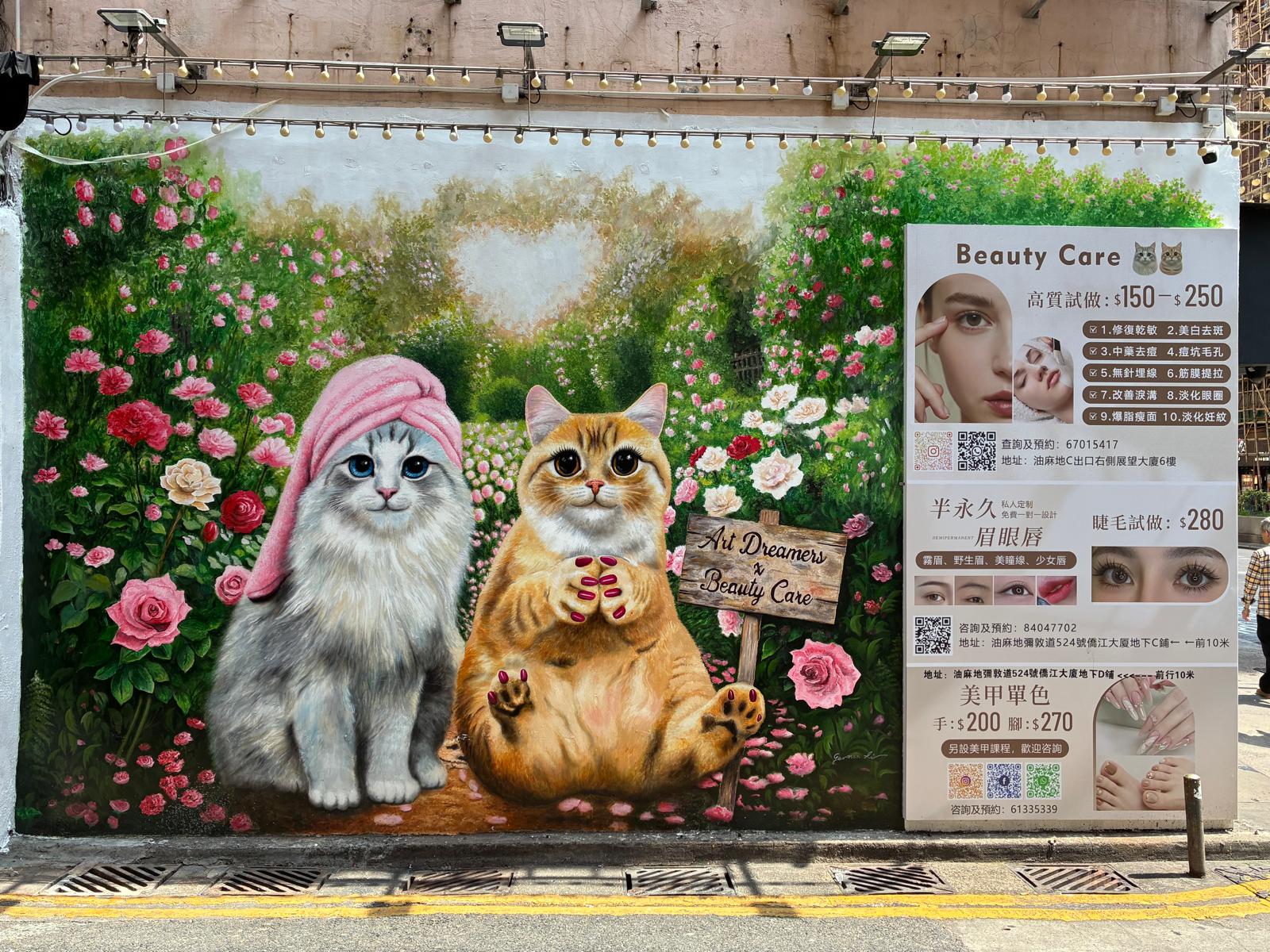
In the district of Yau Ma Tei on the mainland of Hong Kong there are numerous murals dedicated to cats. The most recent addition, in March 2026, was painted by the Hong Kong artist, Li Hok-fung, and his students, the art collective Art Dreamers. A popular Instagram spot, it depicts two cats sitting in a recogniseably English garden of grass (which doesn’t grow in Hong Kong) and pink roses, one with its head wrapped in a pink towel after a grooming session, the raised claws of the other painted with pink nail varnish, its lashes curled with mascara. The realisation in popular culture of the kitsch art of the US appropriation artist, Jeff Koons, this image was reproduced and commented upon in the South China Morning Post as though it were an important work of art and contribution to the culture of Hong Kong, and has drawn crowds of Hongkongers looking, as they always are, for an opportunity for a selfie and, on uploading it to their social media accounts, what they call a ‘viral sensation’. Like the other murals, however, it is an advertisement, in this case for the beauty salon located next door called Beauty Care, the name of which is included with that of the art collective on a wooden sign painted next to the cats in the garden.
‘This dying generation’ is a reference to ‘These dying generations’ in W. B. Yeats’ poem, ‘Sailing to Byzantium’, which begins: ‘That is no country for old men’. Written in 1926 when the author was 61 years old, it was subsequently used as the opening poem of The Tower (1928), in which Yeats meditates on old age. The reference here, however, is to the ageing population of China generally, and even moreso of Hong Kong, which has a median age of 47.9, with 22.7% of the population being 65 and over, and a birth rate of 0.68 children per woman, one of the lowest in the world.
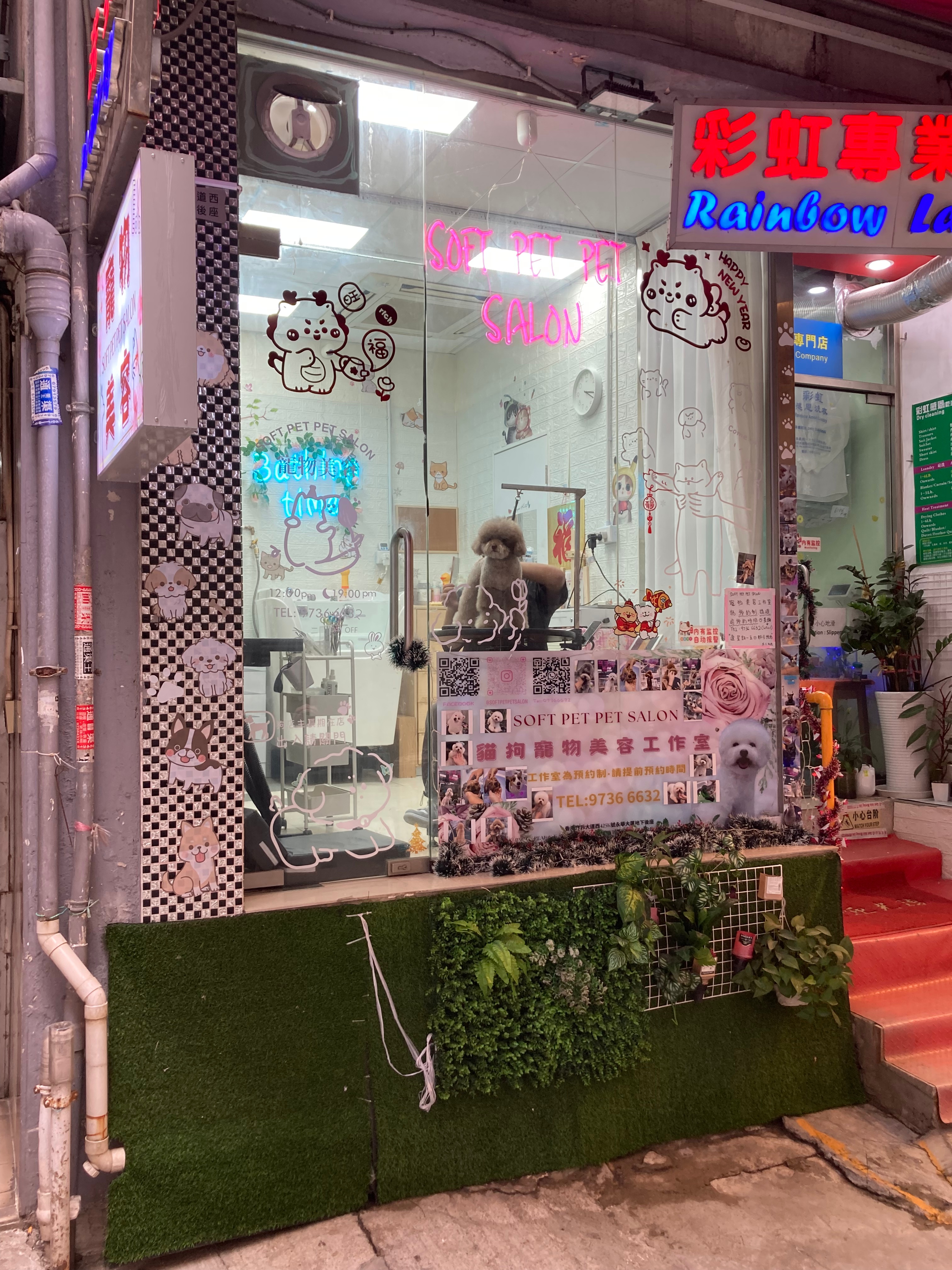
The relationship of the Chinese to their pets is one of the dialectical images through which we can view their difference from us in the West, and particularly in Britain. In Hong Kong, the keeping of pets, which is particular to the middle classes, is a legacy of British colonialism; but the practice has more recently spread across China’s cities. In 2024, there were 128 million pets in China, more than the number of children aged four and under. Roughly half of China’s pet owners are under 30 years old, and 65 percent of them have a first degree. They treat them, however, as toys rather than living creatures with needs independent of their own. In Hong Kong, cats are almost never seen because they are kept in the tiny apartments of their owners, without access to gardens or the outside world they view from high up in the tower blocks. Dogs are typically carried or pushed in prams rather than walked, with there being few if any parks where they could be let off the lead, and no expense is spared in their grooming. It’s a common sight to see a Poodle, Shiba Inu or Pomeranian receiving an all-over trim, shampoo and blow-dry that would make me blush with its attentiveness and intimacy. In the Wang Fuk Court fire of November 2025, over 500 pets (approximately 1 for every 4 flats) were trapped in the 7 tower blocks, and at least 63 died.
On our day trip to the city of Suzhou we saw, alongside one of its elegant canals, a restaurant competed for the passing tourists by filling its second-storey floors with, in one building, long-haired cats and, in the other, husky dogs, both of which could be viewed through floor-to-ceiling windows. There were several dozen of each animal, with the cats permitted to venture out onto the tiled roof of the shops below, where they looked down at us with a mixture of bewilderment and disdain. The passing Chinese were as delighted and captivated by this display as they were by the bandaged kitten in Shanghai; and I don’t believe they would have been any less delighted if the cats had been similarly bound and displayed in the restaurant window.
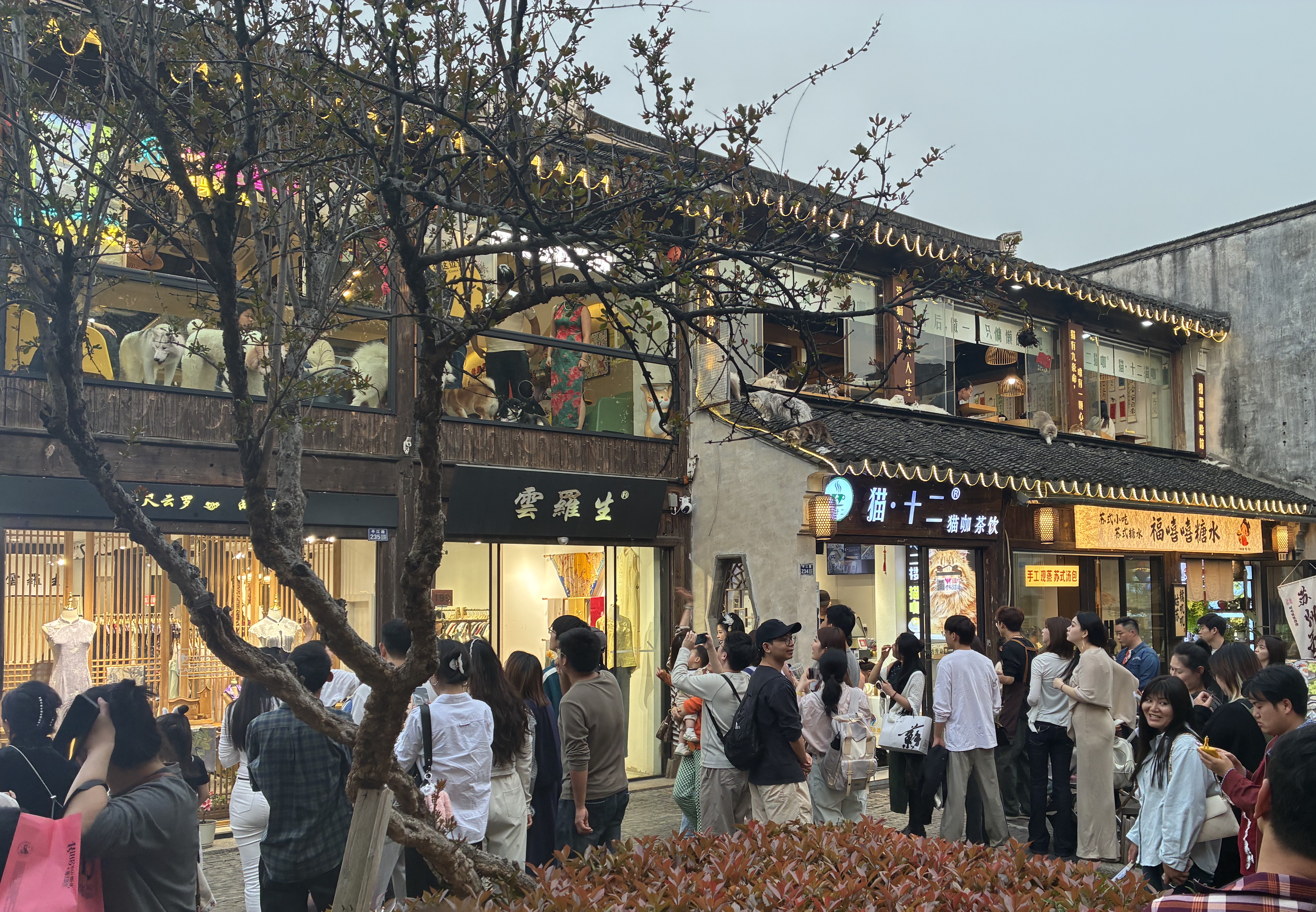
Among this crowd of young tourists we saw, knocking off after a long day’s shift, some of the local workers of Suzhou, male and female. They were from an older generation of Chinese, without exception were physically smaller, but had a swagger about them as they exited the building sites and workshops. It was they who had built the modern-day China being enjoyed by the new middle classes, and they looked at the current generation of smartphone addicts and Labubu brand loyalists with as much bemusement as we did.
‘Sighs and lamentations’ is a reference to l. 22 in Canto III of the Inferno, where Dante hears ‘sospiri, pianti e alti guai’ (‘sighs, lamentations and loud cries’) issuing from those ‘who lived without disgrace and without praise’ (l. 36).
The penultimate line is a reference to Shakespeare’s famous description of death in The Tragedy of Hamlet (Act III, scene 1, ll. 85-86) as: ‘The undiscovered country from whose bourn / No traveller returns’. Like all three parts of the Divina Commedia, my poem ends with the word ‘stars’, not of the saving grace of God, in this case, but of his absence from the universe.
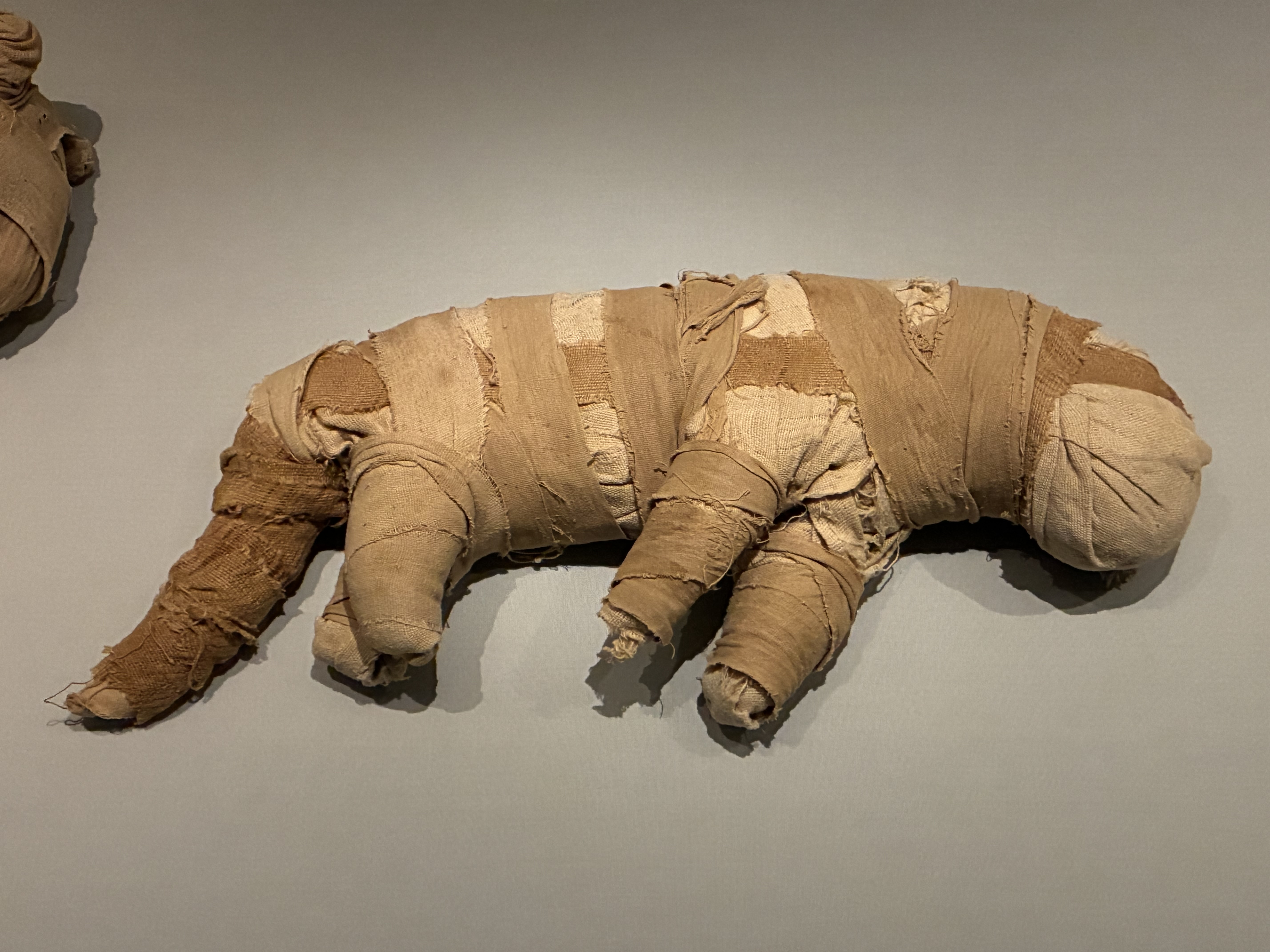
In L’Amour fou (1937), the surrealist poet, André Breton, described chance as ‘the form making manifest the exterior necessity which traces its path in the human unconscious’. After completing this poem I visited the Hong Kong Palace Museum to see an exhibition I had deferred seeing for some time, ‘Ancient Egypt Unveiled: Treasures from Egyptian Museums’, and saw a display of mummified cats. Around 2,500 years old, they had been excavated at Saqqara, the main necropolis of Memphis, the capital of the Old Kingdom; and among them, to my surprise, was a mummified kitten, roughly the size of the one I had seen in Shanghai, bound round with strips of white linen.


Horrific! And a successful, suitably horrifying, poem.
LikeLiked by 1 person