As British administration ends, we are, I believe, entitled to say that our own nation’s contribution here was to provide the scaffolding that enabled the people of Hong Kong to ascend.
— Chris Patten, ‘Hong Kong Handover Ceremony Address’ (1997)
On this dormant volcano’s side, ceaselessly
Erupting roads and towers, last night’s food,
This morning’s crowd, vomiting into the harbour
00000000the victims of its appetite —
00000000fish heads, goose intestines, pig tripe,
Cantonese tongue and Filipino feet
Swallowed on a newly-escalatored street
By the busily indifferent
00000000and the languidly attentive alike,
00000000where each new day destroys what was
While laying the foundation for what will be:
Profits from the biggest drug deal in Britain’s history.
Aden Gibraltar Singapore Malta
Bahrain Brunei Abu Dhabi Dubai
Qatar Ceylon Kuwait Hong Kong

1
On Bonham Road, named after the third Governor,
0000(For service as which Sir George was made
0000Of the Order of the Bath a Knight Commander)
In the canyon between the engineering marvels
Of the expat enclaves in today’s Mid-Levels,
Foreign domestic workers in indentured servitude
Walk the poodles of their owners
00000000collect the children of their masters,
Who use them as they use their smartphones
00000000in the air-conditioned McDonald’s.
水00000000000000000And the schoolboys dressed all in white
街00000000000000000Who clatter, two by two, down the
水00000000000000000Narrow stairs of Anglican schools
水00000000000000000To the broad steps of Water Street,
水00000000000000000Where once a river ran as swift
水00000000000000000To the waves of Victoria Harbour
水00000000000000000From the woods of Victoria Peak.
From High Street, so named not only because
In Cantonese the number ‘Four’ sounds like ‘Death’,
But because they were banned from living above it
By the British — today, for an epitaph,
The only extant lane is called West End Path
Behind the former insane asylum
Reserved, by the British, exclusively
For the curing of Chinese madmen.
On this Little High Street Kensington
Westerners served by South-east Asian waiters
Dine on fifty-Hong-Kong-dollar oysters
00000000artisanal dishes a la carte
In Japanese or American bars
On French, Italian and Spanish cuisines:
Completing Kau Yan Church’s Tsung Sin Mission
To convert the Hakka immigrants
To the rewards of globalisation —
Ugly White men with pretty Hong Kong women.
薄00000000000000000Through which Pok Fu Lam Road descending
扶00000000000000000From the Wild Duck Woods to the west
林00000000000000000And their seventeenth-century village
道00000000000000000Turns and dips into Sai Ying Pun —
玫00000000000000000Where Rose Lane runs like a sunken seam
瑰00000000000000000Through a buttressed wall of granite
里00000000000000000Holding up the island’s terraces
水00000000000000000To the banks of a covered stream.
Western Street’s an occidental descent
Through familiar new developments
Given names like King’s and Kensington Hill
By Hong Kong’s property developer cartel;
Past the disused Western Magistrates’ Court
To the Western District’s Police Headquarters
At whose entrance, still, stand two British cannon —
Stockholm syndrome of colonialism.
2
Come closer now, through the yellowing haze,
And watch the workers in the shadowed lanes
As they swim like fish through the steaming day.
英00000000000000000On Ying Wa Terrace, the terraced
華00000000000000000Homes demolished in the Eighties,
臺00000000000000000Have been replaced by tower blocks
水00000000000000000Signposted ‘Private Property’.
餘00000000000000000But the exhibition video
樂00000000000000000Does not reveal what happened to
里00000000000000000The residents of Yu Lok Lane
水00000000000000000Evicted for a museum.
長00000000000000000Of their passing, all that remains
安00000000000000000Are the worn steps to Centre Street
里00000000000000000As they crossed into Cheung On Lane,
水00000000000000000The dead end of speculation.
兩00000000000000000On the broad steps of Leung I Fong
儀00000000000000000The Puppy Love Pet-Grooming Spa
坊00000000000000000Competes for the childless locals
水00000000000000000With a hair salon and yoga class.
元00000000000000000Yet in the cool of Un Shing Lane
勝00000000000000000A banyan tree still casts its shade
里00000000000000000On a shrine of smiling Buddhas,
水00000000000000000Guan Yu, the red-faced warrior,
水00000000000000000Guanyin, the goddess of mercy,
水00000000000000000And other guardian deities.
Here, for a while, can you hope to escape
The mechanical sounds from Third Street:
Electric cars raised on hydraulic lifts
By a vacant lot turned municipal tip.
福00000000000000000Above the steps on Fuk Sau Lane
壽00000000000000000East meets West where the middle classes
里00000000000000000Dine in Asian-fusion restaurants
00)))000000000000000For the waiters’ weekend wages.
譚00000000000000000But the cast-iron manhole covers
里00000000000000000Beneath Tam Lane’s podium towers
水00000000000000000Are the only trace remaining
水00000000000000000Of the vanished tong lau housing.
常00000000000000000And on the steps of Sheung Fung Lane
豐00000000000000000The keeper of Fuk Tak Temple,
里00000000000000000Dedicated to the Earth God
水00000000000000000In the wake of the Hong Kong plague,
水00000000000000000Refuses to look at, speak to,
水00000000000000000Or otherwise acknowledge me
水00000000000000000An unbelieving foreigner —
水00000000000000000But sits on a stool throughout the day
水00000000000000000His gaze transfixed, as people pray,
水00000000000000000By a smartphone screen.
水0000000000000000000000000000000000000O Sai Ying Pun,
水00000000000000000What demons walk among you still?
Will the paper dragon that at New Year danced
Down Third Street to lucky No. 88
Protect you through this Year of the Dragon
000000000000or deliver you to your fate?
德00000000000000000Of Tak Sing Lane’s tiled-roof terrace,
星00000000000000000Where 1950s tenements
里00000000000000000Stand on land that’s advertised
水00000000000000000By a British estate agents?
爹00000000000000000Or to the end of David Lane,
核00000000000000000Where overpaid professionals
里00000000000000000Eat overpriced all-day breakfasts
水00000000000000000And ‘English’ means inedible?

3
Here on Centre Street, site of the first sewer,
Now covered by an outdoor escalator,
The once-crowded slope of market stalls
Have been sanitised under concrete halls
0000(One for vegetables, live seafood, fresh meat,
0000The other for hawkers chased off the street)
And where, despite the anniversary cheer,
Notice of the seventy-fifth year
Of the People’s Republic of China
Has been kept to a solitary poster.
But outside in the heat, where mainland brides
Pose for the cameras of their sweating grooms,
Grey-haired women the size of children
Born into the Great Chinese famine
Haunt Instagram posts like ghosts of themselves:
Their backs bent double by a state pension
Collecting cardboard boxes off the street
Piled high on carts they push with bunioned feet.
元00000000000000000Un Fuk Lane has been cut in two
福00000000000000000By twenty floors of Tong Nam Mansion.
里
郭00000000000000000And the quiet of Kwok Hing Lane
興00000000000000000Is threatened by more construction.
里
匯00000000000000000But by the carpark on Ui On Lane
安00000000000000000Birds still sing in the public garden.
里
On Second Street, where the two ugly slabs
Of Island Crest have been erected
On the ruins of nine demolished blocks
And the names of four lanes forever lost —
子 泰 餘 餘00000000000Yu Po Lane East
同 來 步 步00000000000Yu Po Lane West,
巷 里 里 里00000000000Tai Loi Lane and
0000西 東00000000000Zi Tong Alley —
Hong Kongers buy Western food imported
By an offshore holding supermarket
At whose door, stray cats, looking undernourished,
Strike poses for the screens of Chinese tourists.
三00000000000000000Behind Ping Pong, where cocktails cost
多00000000000000000Four hours of the waiters’ wages,
里00000000000000000A woman, her bedroom window
水00000000000000000Opened wide onto Sam To Lane,
水00000000000000000Sings a lonely karaoke
水00000000000000000Drowning out her misery,
水00000000000000000Oblivious to the smokers
水00000000000000000Fallen silent at her beauty.
On First Street, by the Department of Labour,
A sushi bar and a pizza parlour
Interrupt the run-down terraces
Of sweating men in construction hats
And scowling women in laundromats
And the workers who queue patiently
At the exit from the Mass Transit Railway
00000000for a bus to somewhere else.
西00000000000000000And where Sai Wa Lane emerges
華00000000000000000Onto the climb up Western Street
里00000000000000000Unlit stairwells in Chinese blocks
水00000000000000000Ascend like mineshafts into rock.
亞00000000000000000Down here, in sinking Algar Court,
厘00000000000000000A brown rat escapes through a hole
架00000000000000000In the lid of a broken drain;
巷00000000000000000And an ancient Chinese woman
水00000000000000000Carries two microwave ovens
水00000000000000000Down the steps from her condemned home;
水00000000000000000Above which, serviced apartments
水00000000000000000Look down on an urban renewal zone.
4
Follow them down to the old Chinese town
Where no human greeting troubles the calm
And the air tastes of the sweat in your palm.
Queen’s Road West, once a fishermen’s path
That wound between the mountain and the sea
To the camps of the British garrison
And the brothels between First and Third Street,
Today services massage parlours and spas,
Purveyors of Chinese medicines
And second-rate hotels displaying four stars
Behind a veil of bamboo scaffolding.
朝 西000000000000000By the rutted steps of Sai Hing Lane,
光 興000000000000000Through a table saw’s hungry teeth,
街 里000000000000000A carpenter pulls lengths of timber
水00000000000000000As they climb onto Chiu Kwong Street.
荔 兆000000000000000On Siu Cheung Fong a curtain-maker
安 祥000000000000000Converses in fluent English,
里 坊000000000000000But in Lai On Lane the hotel staff
水00000000000000000Curse in demotic Cantonese.
石00000000000000000Down broken steps to Shek Chan Lane
棧00000000000000000Hong Kong artists with Western eyes
里00000000000000000Have painted walls they haven’t seen
水00000000000000000In the international style.
奇00000000000000000On Ki Ling Lane, where Henderson Land
靈00000000000000000Has built ‘a community, with heart’:
里00000000000000000Rainbow steps and potted plants
水00000000000000000And murals of saccharine art.
忠00000000000000000In local defiance of which,
正00000000000000000On the doorsteps off Chung Ching Street
街00000000000000o00A pantheon of household gods
水00000000000000000Warns culture tourists to retreat.
西00000000000000000And at the end of Sai Yuen Lane
源00000000000000000A waving cat greets supplicants
里00000000000000000To the shrine of a laughing Buddha
水00000000000000000Embraced by giggling Chinese children.
水00000000000000000Above which, on an unnamed lane,
水00000000000000000The scent of freshly laundered clothes
水00000000000000000Mixes with the cooking smells
水00000000000000000From the kitchens down below.
桂00000000000000000On Kwai Heung Street, where a banyan
香00000000000000000Tree clings to a public toilet,
街00000000000000000Pencil towers cast their shadows
水00000000000000000Across the last tenement blocks.
水00000000000000000While on the corner, teenagers水水水水
水00000000000000000Drawn by a video on TikTok
水00000000000000000Queue to sit in a restaurant
水00000000000000000That tomorrow will be vacant.
And from the Chinese shops on Eastern Street
Every neighbourhood west has been gutted
By the Urban Renewal Authority
With the tools of their gentrification —
00000000One Art Lane and Two Art Lane
00000000Artisan House, The Met. Sublime,
00000000Ramada Hong Kong Harbour View,
00000000a new station on the Island Line,
And other speculative investments
Of the Leisure and Cultural Services Department.
崇00000000000000000Planning for which was granted
慶00000000000000000For the price of a children’s playground
里00000000000000000On the remains of Sung Hing Lane
水00000000000000000By the Western District Council.
梅00000000000000000But in the park on Mui Fong Street
芳00000000000000000Hybrid orchids still bloom in the spring,
街00000000000000000Their sterile flowers drained of colour
水00000000000000000On the blood-red flag of Hong Kong:
水00000000000000000Symbol of the devolution
水00000000000000000Of Sino-British relations;
水00000000000000000A nightingale of Philomel
水00000000000000000In the tree of occupation.

5
Now the kite takes wing with the setting sun,
Circles the city on the rising heat
And scavenges a meal from the baking streets.
Off Wilmer Street, a herd of seahorses,
Sorted large and small, dry on sun-baked bricks;
Their knightly profiles destined for the guts
Of incontinent and impotent pricks.
And in the window of a restaurant
00000000lobsters waiting to be eaten
Wage war with claws tied in rubber bands —
A metaphor, but for something forgotten.
紫00000000000000000On what’s left of Tsz Mi Alley
薇00000000000000000Where Chinamen laugh at Gweilo
街00000000000000000Stockrooms supply the shops out front
水00000000000000000With every kind of dried seafood.
西00000000000000000But at the top of Sai Woo Lane
湖00000000000000000Beside the brand-new football park
里00000000000000000Workers relax in the shadows
00000)))000000000000Of the final timber yard.
By the former shoreline, where Des Voeux Road
Bears the name of a Huguenot Governor
Who segregated European villas
From the Chinese tenements below,
Today, for a flat fare, the same trams carry
The descendants of their residents
Past the old and newer monuments
To their successive colonisations:
Best Western Plus Hotel’s Egyptian style,
Island Pacific Hotel’s postmodern pile,
The ’60s retro of Bohemian House,
Eco Tree Hotel’s virtuous ugliness,
And the Neo-Art-Deco Liaison Office
Of the Central People’s Government in Hong Kong,
The glass sphere of its executive clubhouse
Glittering like a star over Sai Ying Pun.
鹹00000000000000000Last of all now, on Ham Yu Street,
魚00000000000000000Where salted fish was a local trade
街00000000000000000Before Britannia ruled these waves,
水00000000000000000Workers on their evening break
水00000000000000000Remove their masks, smoke cigarettes
水00000000000000000And consult their phones, as they do
水00000000000000000On every lane of Sai Ying Pun —
水00000000000000000Vanishing networks of a community.
Beyond lies Connaught Road, until recently
A waterfront promenade of wharfs and piers
Named after the third son of Queen Victoria
By a successfully knighthood-seeking Governor;
Now buried beneath a four-lane flyover
Since the land was reclaimed from beneath the waves
For a Memorial Park to Sun Yat-sen,
Father of the Republic, in a town
Where no monument to Mao can be found.

6
These and such curious observations
My uncomprehending thoughts disturb,
Scratching these pages with unanswered words.
When the smile of an equatorial moon
Is shadowed by a South China Sea monsoon,
And the low clouds’ groping hands reach the waists
Of the high-class skyscrapers they slyly embrace,
And night creeps up the hill, hungry as the tide,
Behind noisy bars and bright-lit restaurants
Unregistered immigrants turn and hide
Down the granite steps of their concrete haunts.
And in high-rise luxury apartments
Of upmarket families, on kitchen floors,
In corridors and on their balconies
00000000foreign domestic workers
Denied the right of permanent residency
00000000sleep like exotic birds
Under the mesh of Hong Kong’s aviary.
Yet at every new morning’s sun they rise
With turquoise, jade and ruby plumes for smiles.
— Hong Kong, March 2024-May 2025

• • • • •
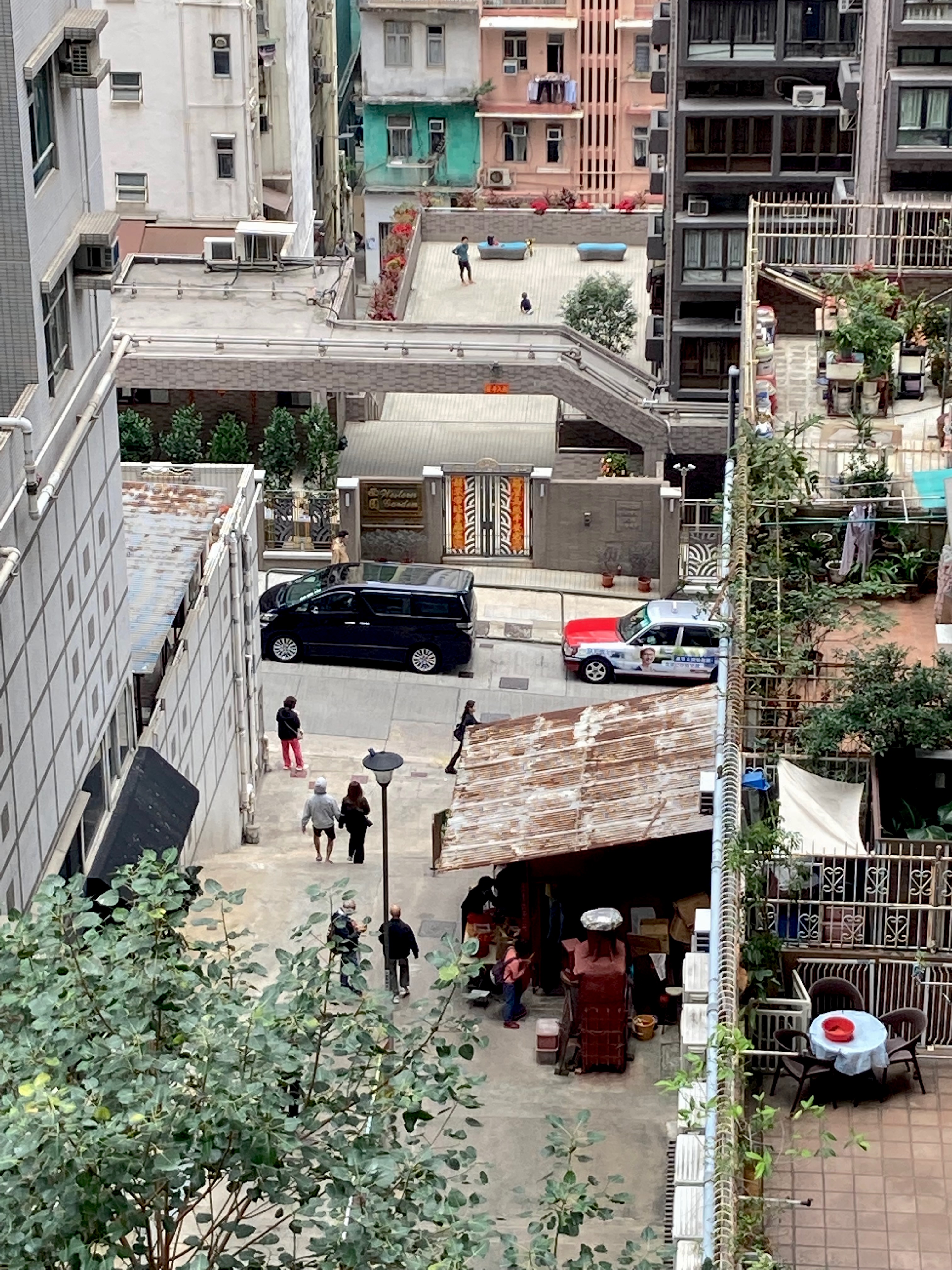
Sai Ying Pun, one of the oldest districts of Hong Kong, means ‘Western Garrison’, and was where the British occupation forces were initially stationed. In 2001, Sai Ying Pun was identified by the Hong Kong Government as one of nine areas targeted by its Urban Renewal Strategy. In 2010, an escalator was completed on Centre Street, moving incomers up the steep slope; and the same year, changes to the criteria for the ‘Land (Compulsory Sale for Redevelopment) Ordinance’ made it easier for private developers to demolish existing buildings. Since March 2015, when the Island Line of the Mass Transit Railway was extended into this working-class neighbourhood, it has been subjected, under the direction of the Urban Renewal Authority and the Leisure and Cultural Services Department, to a strategic programme of rapid gentrification. I have been a resident of the neighbourhood since January 2024, and as a newcomer to the area I have contributed to this process, residing as I do in one of the new developments built on the demolition of several tong lau (‘Chinese buildings’). These are narrow and usually cantilevered tenement blocks that were still being built in Hong Kong up to the 1960s, and in which the residential floors, typically between 3 and 6 stories high, were built over a ground floor reserved for commercial use.
Under the pressure of a Chinese population fleeing the excesses of the Cultural Revolution in the 1960s and the lure of profits to be made from property development following the economic reforms of the 1980s, many tong lau have been demolished. Initially, these were replaced by the high-rise blocks that characterise Hong Kong’s extraordinary urban density, and whose podiums typically occupy the same footprint as the tong lau terraces before narrowing into towers of 25 or more floors. However, since the ‘handover’ of the former British Crown Colony to the People’s Republic of China in 1997, this housing is itself being replaced by upmarket investments for the latest eruption of people and money into the Special Administration Region. These include not only Westerners but also, and in far greater numbers, Hong Kong’s expanded middle-classes, who have grown rich on forty years of neoliberalism. This has brought to Sai Ying Pun the plagues of gentrification, property speculation, unaffordable housing and the consequent social cleansing of the working-class community.
In ‘A Few Don’ts by an Imagiste’ (1913), Ezra Pound warned the would-be poet about mistaking verse for descriptions of a view, in place of which he advises presentation of the image. If, in trying to present an image of this neighbourhood, I have occasionally fallen into describing what I see, my aim has been to show how the legacy of British colonialism has been built not only into the architecture of Hong Kong but also into its economic and social relations. The lanes of Sai Ying Pun, which largely retain their Cantonese names — the origins and meanings of which are obscure even to the Cantonese — constitute a second, parallel economy and society existing between that of the streets, which were named by the British. These lanes have been my route into this relationship. The geography of this poem flows, with many twists and turns, from south-west to north-east into Victoria Harbour.
The transliteration into Roman characters on the street signs bear at best an approximate relation to the sound of the Cantonese, which to my ears sounds like a sort of cockney Mandarin; but for purposes of pronunciation in my poem, the ‘Cheung’ in Cheung On Lane is pronounced ‘Chang’; the ‘Leung I’ in Leung I Fong is ‘Lang Yee’ (‘Fong’ meaning Square); the ‘Un’ in Un Sing Lane and Un Fuk Lane is ‘Yun’; the ‘Fuk’ in Fuk Sau Lane is ‘Fook; the ‘Sheung’ in Sheung Fung Lane is ‘Sang’; the ‘Kwok Hing’ in Kwok Hing Lane is ‘Guo King’; the ‘Ui’ in Ui On Lane is ‘Wee’; the ‘Po’ in Yu Po Lane East and West is ‘Bo’; the ‘Loi’ in Tai Loi Lane is ‘Lai’; the ‘To’ in Sam To Lane is ‘Dor’; Chui Kwong Street is pronounced ‘Tui Gwong’; Sui Cheung Fing is ‘Siu Chang Fong’; the ‘Chan’ in Shek Chan Lane is ‘Zan’; Chung Ching Street is ‘Song Hing’; the ‘Kwai’ in Kwai Hueng Street is ‘Gwai’; Sung Hing Lane is ‘Ching Tsing’; Mui Fing Street is ‘Muoi Fong’; and the ‘Mi’ in Tsz Mi Alley is ‘Me’. As can be seen (and heard), the British colonisers — as continues to be the case today — had little ear for the blended consonants and different vowel tones of Cantonese.
The opening image was suggested to me by Federico García Lorca’s ‘Landscape of the Vomiting Crowd (Twilight at Coney Island)’, from Poeta en Nueva York (1940).
In the museum housed in the four refurbished buildings that are all that remain of the tong lau on Yu Lok Lane, which were demolished in 2013 by the Urban Renewal Authority, is a text reading: ‘The open space shared outside the buildings formed some rows of shared space called “Li [Lane]”. . . . Neighbours could relax, enjoy the soothing shades, and socialize with one another in the lane, forming a community network.’
On its website page for ArtLane, Henderson Land Development Company Ltd., one of the largest property developers and land bankers in Hong Kong, with 10.4 million square feet of property investment in Hong Kong and 13.0 million square feet in China, including One ArtLane and Two ArtLane in Sai Ying Pun, writes: ‘As one of the leaders in urban renewal, Henderson Land has always been committed to developing an integrated community with heart. . . . Seventeen well-known local and international muralists were invited to inject vitality and arts to the urban landscape of Sai Ying Pun.’
Philomel (Φιλομήλη), a minor figure in Greek tragedy, was the younger daughter of the King of Athens. After being raped by her elder sister’s husband, who cut out her tongue to silence her, she was transformed by the gods into a nightingale. In John Dryden’s translation of the myth in Ovid’s Metamorphoses, she cries:
00000000Or tho’ I’m prison’d in this lonely Den,
00000000Obscur’d, and bury’d from the Sight of Men,
00000000My mournful Voice the pitying Rocks shall move,
00000000And my Complainings echo thro’ the Grove.
In this regard, I don’t know whether the Philomel in my poem is singing in the tree of occupation or exile.
My poem is dedicated to the Hong Kong architect, Jersey Poon, who walked with me through the lanes of Sai Ying Pun and helped elucidate some of their more obscure aspects.
 Simon Elmer
One thought on “Western Garrison”