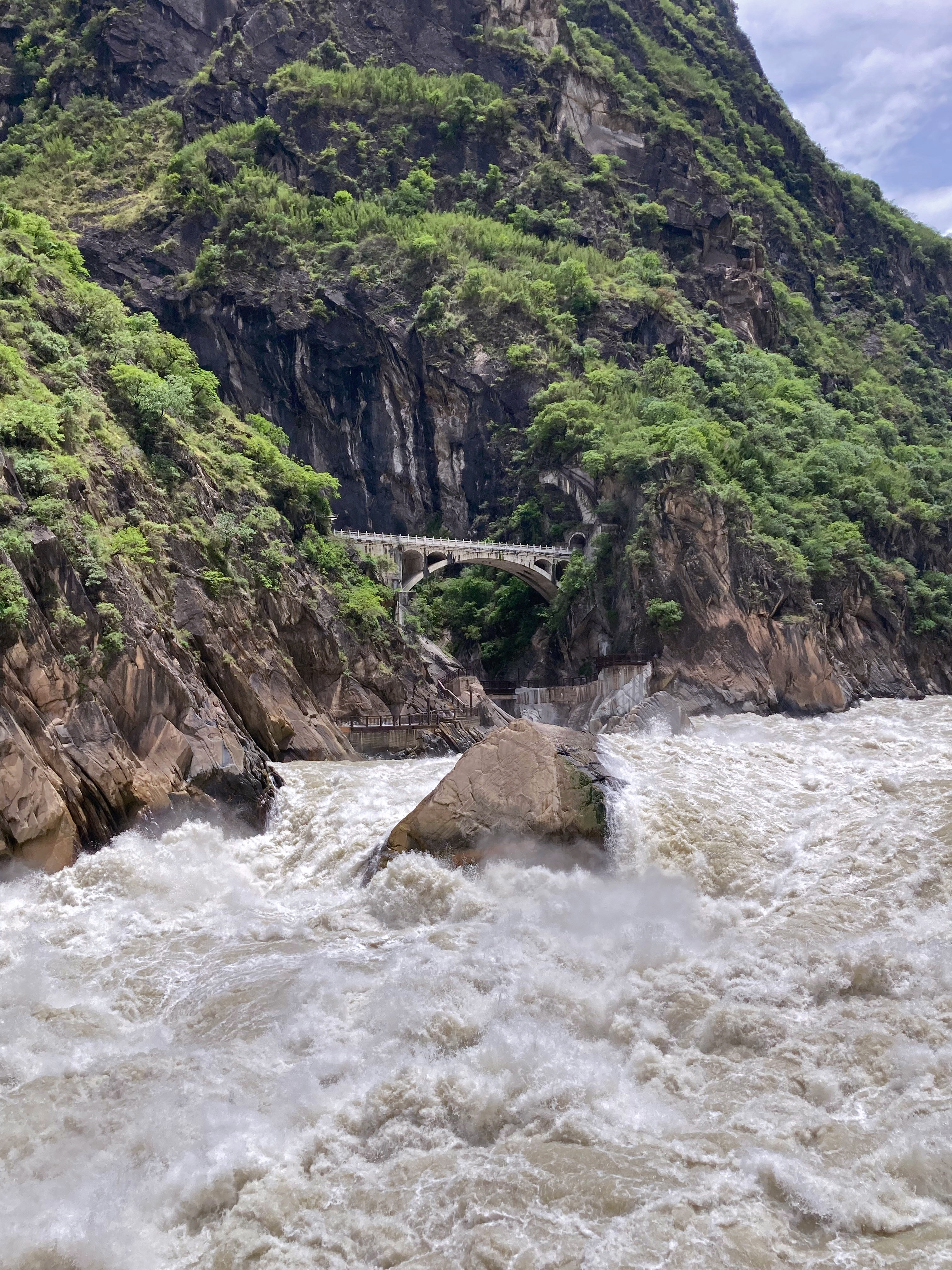
In the upper reaches of Tiger Leaping Gorge,
Where the rapids of Jinsha River cut their way
xxxxBetween mountains of unmelting snow
In a torrent of gold water and silver spray,
xxxxAnd the shadowed cliffs on either side
Ascend to sunlit peaks five-thousand metres high —
Chinese tourists, beneath masks and white umbrellas,
Queue patiently to have their photograph taken
xxxxBefore the statue of a tiger
That leapt the ravine onto this viewing platform,
xxxxThen take the escalator to the top
Where their coaches wait, exiting through the gift shop.
But nine decades past, at the first bend of the Yangtze,
Where the river splits to shoals, slows and turns northward,
xxxxThe Second Corps of the Red Army,
Over three days and nights, in boats and bamboo rafts,
xxxxLeft the conscripts of the Kuomintang
In the wake of the Long March, by mountain and marsh.
In the east, the beacons are lit across Yunnan,
But the red flags point straight to the Jinsha River.
xxxxHarried by the enemy’s cannon,
We ferry soldiers across, overcome with joy,
xxxxAnd watch as the Jade Dragon Mountain
Spreads its snow like scales, then march north with our comrades.
— Tiger Leaping Gorge, June 2025
• • • • •
The Jinsha River (金沙江), which rises on the Tibetan Plateau, is the name the Chinese give to the upper reaches of the Yangtze River, which reaches the East China Sea nearly 4,000 miles away at Shanghai. Jinsha, meaning ‘gold sand’, refers to the alluvial gold that flows through its waters and is still panned by prospectors. Where it runs north between Haba Snow Mountain and Jade Dragon Snow Mountain, Jinsha River forms Tiger Leaping Gorge, which at 3,790 metres from river surface to mountain peak is one of the deepest gorges in the world, and more than twice the depth of America’s Grand Canyon. Local legend tells that, using a large rock in the midst of the torrent, a tiger leaped across the Jinsha at its narrowest point.
When we arrived in Shangri-La, we visited the Museum of the Red Army’s Long March, which included a huge diorama of the Red Army crossing the marshes and mountains of Yunnan, and was one of the best of the communist museums I’ve visited in China (in Beijing, Kunming, Shanghai and Shangri-La). At the exit was displayed a poem titled ‘Crossing the Jinsha River to the North’ by General Xiao Ke, who had commanded the Sixth Army in 1936. Xiao was a warrior-poet, and it has been said that, in order to understand the difficulties endured by the Red Army on the Long March, you have to read his poems. This poem, which is composed of four couplets in eight lines of seven-character regulated verse, and from which my final stanza is derived, was written in April 1936, at the time of the crossing of Jinsha River. It was presented by Xiao to the Museum in his own calligraphy in 1986 on the fiftieth anniversary of the crossing.
Denounced by Mao in 1958, interrogated and dismissed from his military and political positions, Xiao was exiled in 1969 during the Cultural Revolution, but returned and was made Deputy Minister of Defence in 1972, and had his name cleared after Mao’s death in 1976. From 1982 he sat on the Central Consultative Committee, in which capacity he advised Deng Xiaoping against calling the army in to crush the Tiananmen Square protests of 1989. ‘Since the People’s Army belongs to the people,’ he wrote in a letter to Deng, ‘it cannot stand against the people, much less kill the people, and must not be permitted to fire on the people and cause bloodshed.’ An advocate of accurately recording the Long March and the role of the ordinary soldier in its success, Xiao was an outspoken opponent of the cult of personality that continued around Mao even after his death. The last surviving commander of the Long March, Xiao died in 2008 at the age of 101.
Conducted between 1934 and 1936 in order to escape the encircling movements of the far larger forces of Chiang Kai-shek’s Nationalist Government (Kuomintang), the Long March was undertaken by numerous corps of the Red Army, which on average covered between 6,000 and 8,000 miles. By the time it was over, its 160,000-strong force had been reduced to 15,000 soldiers, and Mao Zedong, whose guerilla tactics won him the esteem of his comrades, had been elected Chairman of the Military Commission and the defacto leader of the Communist Party of China. Since it passed through 11 provinces between Jiangxi in the southeast, Yunnan in the southwest and Shaanxi in the northwest, bringing the reality of an anti-imperialist communist revolution to large parts of China, the Long March is in many ways the foundation myth of the People’s Republic of China, and is commemorated today in every town and city through which it passed.
 Simon Elmer
G’day Simon:
Touche!
Is it the same ‘Simon’ from UK (anti-Covid19 fame)?
LikeLike
Very nice. The replacement of poetic struggle by insignificance, eh? I particularly like the rhythms, which I take to be in imitation of those of traditional Chinese forms. And, judging from the poem, and in addition the photo, what an impressive place it must be! We need more generals like the hero Xiao Ke.
LikeLike
Thank you, Stephanos, and yes, Xiao’s a fascinating figure. I think all military and political leaders should be required to write poetry. We might have a better calibre of person than the robots we have now.
LikeLike
PS You probably already know all this… Inspired by your poem, I looked him up and found this:
https://thechinabeat.blogspot.com/2008/11/last-general-of-red-army.html
LikeLiked by 1 person