The name over the bar was ‘Mood For Love’,
Drinking in which, we hoped, would put us
In the same mood as Wong Kar-wai’s film,
Which we’d failed to see in two years of searching
In Hong Kong’s commercial cinemas.
But, in memory of Douglas Adams,
We christened it ‘The Bar in the Hotel
At the End of the Universe’, because
That was where, from the banks of the Pearl River,
We watched the end of history arrive
In the shape of a cruise ship dressed in lights
To resemble, we guessed, a serpent
In this Chinese Year of the Snake — sinking
Manhattans and Brandy Alexanders
Inspired, I said, by Brideshead Revisited.
But later that night, when we stumbled home,
Amazon recommended (on your smartphone)
The Hitchhiker’s Guide to the Galaxy —
The wrong book but right author — demonstrating
What the Chinese couple at supper had said:
‘The Government is always listening.’
The lounge-singer from the Philippines
Who at our request sang a medley of songs
To which we danced drunkenly and alone,
Asked me to write them a song for their set
And this is the best I could do. Hope you
Like it and get all the references.
You were by far the best part of Guangzhou,
Where we couldn’t use the Metro, order
A cab, pay for lunch or book a train home
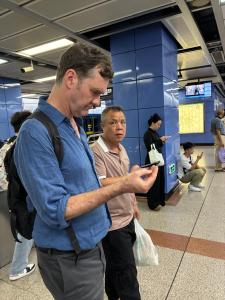
Without the Alipay app on the smartphone
That every Chinese — even when they weren’t
Staring at its screen on station platforms,
Ignoring each other in restaurants
Or just walking blindly down the street — clutched
Like the opium pipes of Old Canton.
But now it’s their hand and not the drug
That’s evolving to clasp the slippery bar
Of plastic and glass, which nonetheless fall
To the floors of taxis, trains, concert halls, bars
And other carpeted interiors
With a by-now-recogniseable thud.
A second-class ticket on High-Speed Rail
Took us to the future we’d tried to escape
From the other side of the planet,
Arriving, blinded by the glass and heat,
At this post-apocalyptic polity
Of strength through joylessness, where beauty
Has been traded for the spectacle
And desire for the smile of a prostitute.
And no-one knows the difference between them
As they pose for a selfie (with their smartphone)
In front of yet another skyline
Of corporate headquarters all lit up
Like Christmas trees every night of the year
In this eternal festival of the present.
But now time’s up and we’re back in Hong Kong,
The reward for sucking the serpent’s tongue,
Looking for a bar in which to witness
The end of the world as we once knew it —
Not with the bang of a nuclear bomb
(The poets were right, the scientists wrong)
But with the last man’s compliant whimper.
— Guangzhou/Hong Kong, October-November 2025
• • • • •



The hotel in which the ‘Mood for Love’ bar is housed is the White Swan Hotel, which was financed by Fok Ying-tung, a Hong Kong developer, and opened in 1983. In the early 2000s, when Fok was a member of the Standing Committee of the National People’s Congress and before he became Vice Chairman of the Chinese People’s Political Consultative Conference, the hotel was handed over to the Chinese Government, and is now owned by the Ministry of Land and Resources of the People’s Republic of China. The Wong Kar-wei film the bar references is In the Mood for Love (花样年华) (2000).
The Douglas Adams novel is The Restaurant at the End of the Universe (1980), the second volume in The Hitchhikers Guide to the Gallery series. The novel, Brideshead Revisited (1945), is by Evelyn Waugh, in which the Brandy Alexanders are drunk by the character of Anthony Blanche. I don’t remember making the connection at the time, at least not consciously, as a reason for ordering a cocktail I hadn’t drunk in many years, but the televised series of both books, which had appeared simultaneously in 1981, also shared the same actor and my namesake, Simon Jones, who appeared, respectively, as Arthur Dent and Lord Brideshead. Whether the AI systems of surveillance made the same connection as my unconscious mind, the recommendation from Amazon demonstrated that, even if you disable the intelligent digital assistant built into Apple’s operating system and turn off the microphone, your smartphone, much like the superego, is still listening to, recording and sharing what you say.
‘Strength through Joy (Kraft durch Freud)’ was a leisure operation founded by the National Socialist Party in Germany in 1933, the year they formed a government, and by 1939 was the largest tourism operator. With the emergence of a newly-rich middle class and as part of its programme to increase internal expenditure rather than relying on exporting products to an increasingly hostile West, China’s travel and tourism industry contributed nearly ¥13.7 trillion (£1.44 trillion) to its economy in 2025, 9.8 percent of China’s GDP, and is predicted to reach ¥27 trillion by 2035.
My reference to the spectacle draws on Guy Debord’s La Société du spectacle (1967), in which he defines the spectacle as ‘capital accumulated to the point it becomes image’. The final lines are a reference to the famous lines from T. S. Eliot’s ‘The Hollow Men’ (1925), ‘This is the way the world ends / Not with a bang but a whimper’, and to Nietzsche’s depiction of ‘the last man (der letzter Mensch)’ in Also sprach Zarathustra (1883-85).
The poem is a condensed but faithful account of our journey, in October 2025, to the cities of Shenzhen (13.5 million people) and Guangzhou (15 million), both of which lie in the Province of Guandong, in which seven additional cities, together with Hong Kong and Macou, constitute the Greater Bay Area, the largest and most populated urban conurbation in the world, with approximately 86 million people and a GDP of ¥14.5 trillion (£1.53 trillion).
 Simon Elmer