Par
a
noi
a-
crit
i
cal
town
where
Sand is raked into waves of a
lake
Bushes are pruned to resemble
rocks
Rocks are arranged to represent
islands
Gardens are raised to look like a
mountain
Canopies of woods trimmed into
clouds
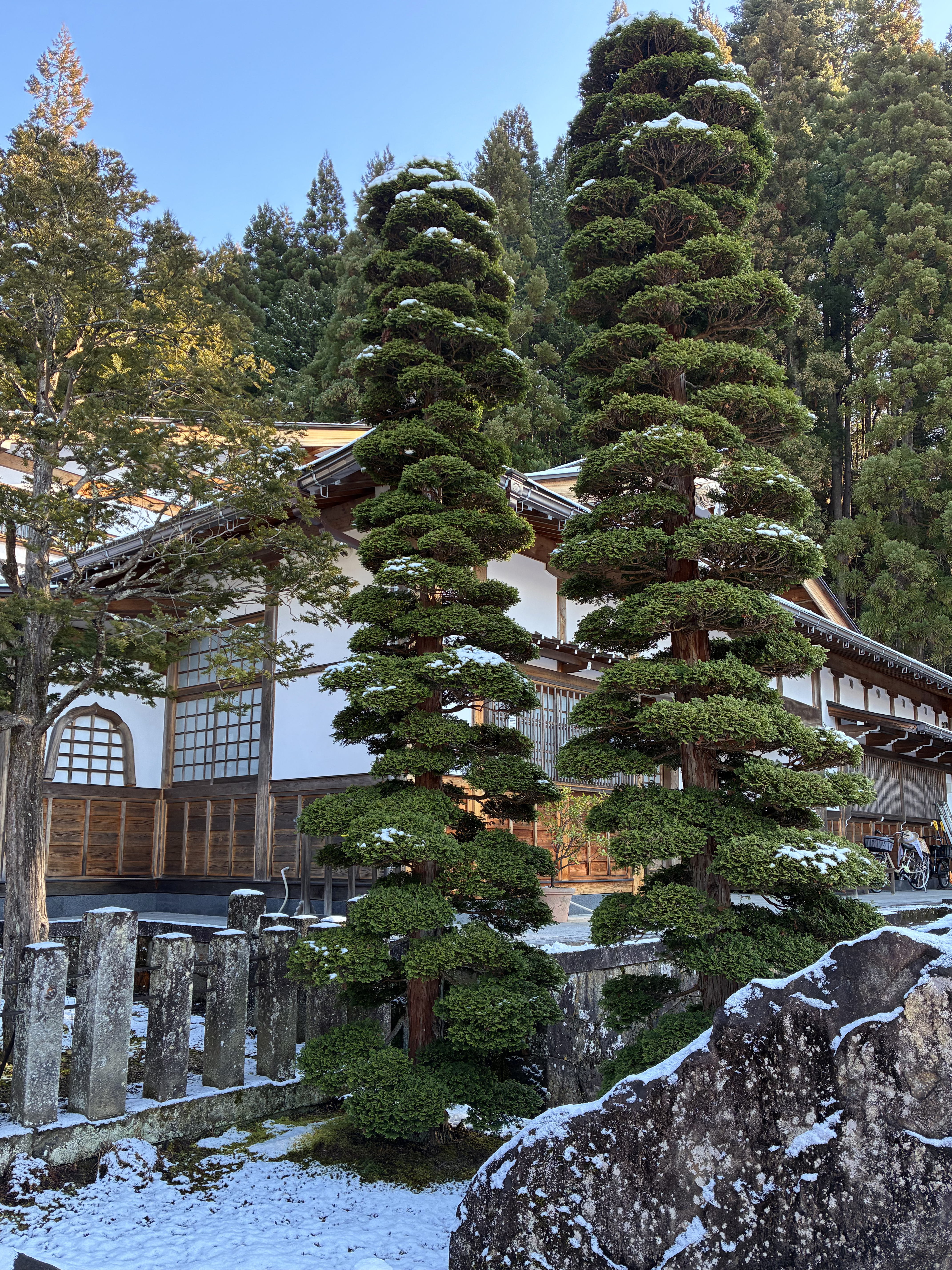
And Niwaki trees sculptured like
pagodas
Whose roofs are pitched to the arc of
heaven.
— Takayama, December 2025
• • • • •

The paranoiac-critical method was an invention of the Spanish painter and surrealist, Salvador Dalí, who included it in such canvas titles as Suburbs of a Paranoiac-Critical Town: Afternoon on the Outskirts of European History (1936), an image that came to my mind when walking between temples in the eastern suburbs of Kyoto. For Dalí, the paranoiac-critical method was an alternative and corrective to what he saw as the passive automatism on which the Surrealist movement had based its concept of automatic writing and its pictorial equivalents in the paintings of André Masson, Max Ernst and Joan Miró. The active recreation of the world by the paranoiac, who sees connections, patterns and concealed intentions in the world invisible to others, all of which converge on himself, offered Dalí a psychic process to which his paintings were the critical equivalent.
I am not overly familiar with the principles of Buddhism or its practices of meditation, but the Buddhist temples that run between the eastern suburbs of Kyoto and the line of hills beyond are distinguished by their gardens, in which an equivalent practice of creation appears to have been deployed, according to which every rock, sandpit, bush, tree and copse has been placed, arranged, raked, pruned and trimmed to look like, resemble, imitate, represent or visually echo something else. Niwaki (庭木) meaning ‘garden trees’ is the Japanese word for trees sculpted in this manner.
The poem is an example of concrete poetry, which, perhaps more than imitations of the haiku, best translates the adequacy between the text and its notation in the calligraphy of Japanese poems.
 Simon Elmer