Is this the Region, this the Soil, the Clime
xxxxxxxxxxx— Milton, Paradise Lost
Entertained by two boys stripped to their boxer shorts,
Their bodies muscular and glistening with sweat
And whose primary intention appears to be
To sink their white teeth into the other’s neck
(A feat in which one of them finally succeeds);
And occasionally disturbed by one or another
Of the conflagration of Indonesian girls
Who, like birds-of-paradise fallen from heaven
(On whom a hellish wind descends in circles),
Try different tricks to distract my attention
From the wall of televisions behind the bar —
Like someone who, dreaming, wishes he were dreaming,
I order round after round of drinks whose prices
I briefly glimpse and immediately forget
On the screens of handheld point-of-sale devices
I never hold in my hand and yet against which
I rub my crebit card as furiously
As the Thai-boxers grapple with each other
On every screen in this underworld — as though
Drinking were a sport I have a chance of winning
With my soul still intact.
xxxxxxxxxxxxxxxxxxxxxAnd that’s entertainment,
As I sit outside with the Kashmiri owner,
A Moslem drug-dealer and money-launderer;
His Russian girlfriend (one of many, he winks
With the parasitic eye of the part-time pimp);
The Nepalese manager moonlighting as bouncer
Whose Italian motorbike gleams in the gutter;
The Filipino singer and mother postpartum
Who lactates on stage crooning Britpop anthems
But still welcomes me by name as I cross the dancefloor;
A Colombian I meet at the cubicle door
And who like everyone else is talking rubbish;
A Kurdish nationalist I greet in bad Turkish
Then order us a round of flaming sambuca;
An Israeli engineer turned cosmetics salesman
(The salary’s better, he says to my unasked question),
An English lawyer for victims of state torture
On whom its dawning he’s in the wrong circle;
And, in the dark before dawn, a young Hongkonger
Who tells me of the protests and how much his city
Has changed under China’s rule.
xxxxxxxxxxxxxxxxxxxxxxxxxxThrough hookah smoke
And trays of shots that someone never ordered,
Our thoughts bent on the pavement and trodden gold,
We discuss the world — the rise of empires and fall
Of angels, and whether ambition is to serve
In Heaven or to reign in this mournful Hell:
Where every value is exchanged for mammon
On the road to an elsewhere we will never reach,
And eternity is the means without an end
Except accumulation of further means,
The limbo of now in sæcula sæculorum.
Above us the long night turns suddenly to day
Aflame in the glass and metal towers
But darkened with the ashes which the morning breeze
Carries heavenward from the human pyres
Burning in the fires of Pandæmonium.
— Hong Kong, November 2025/February 2026
• • • • •
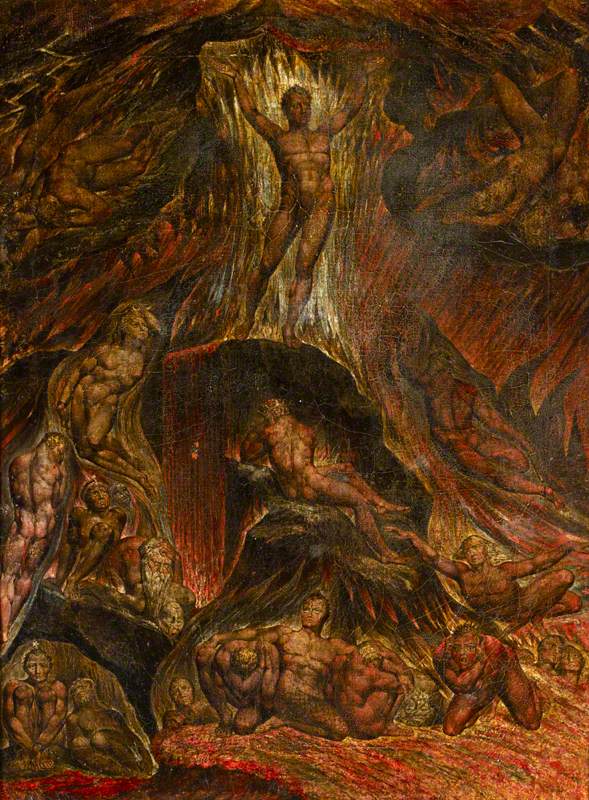
The epigraph is from Book One of John Milton’s Paradise Lost (1667), in which the rebellious archangel, Satan, arrives in Hell, where he arouses the fallen angels with the lines:
Here we may reign secure, and in my choice
To reign is worth ambition though in Hell:
Better to reign in Hell, than serve in Heav’n.
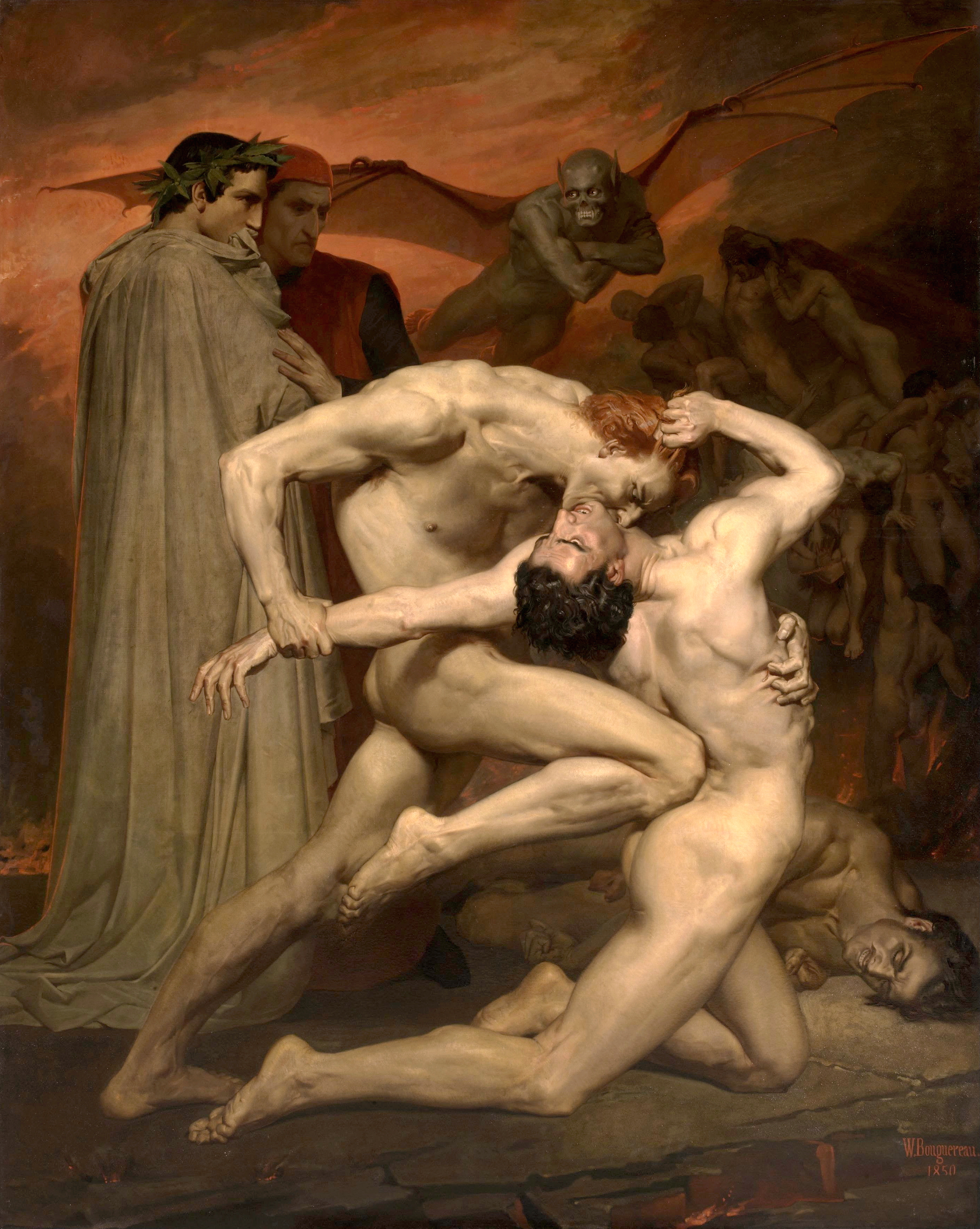
In Canto XXX of Dante Alighieri’s Inferno, in which the poet reaches the eighth circle of Hell that is reserved for falsifiers, Dante sees two naked men, one a defrauder and the other a counterfeiter, entwined in eternal combat, the former of whom sinks his teeth into the latter’s neck. Rebuked by Virgil for his fascination with this gruesome scene, this passage contains the lines:
Qual è colui che suo dannaggio sogna,
che sognando desidera sognare,
sì che quel ch’è, come non fosse, agogna,
‘Even as one who dreams that he is harmed / And, dreaming, wishes that it were a dream, / Longing for what is, as if it were not’. Both these scenes were painted, respectively, by William Blake, Satan Calling Up His Legions (1800-05), and William-Adolphe Bouguereau, Dante et Virgille en Enfer (1850).
The ‘infernal storm (bufera infernal)’ is that which, in the second circle of Hell, chastises those guilty of the sin of lust. Mosques are located in the sixth circle of Hell reserved for heretics, and stand within the City of Dis (Pluto), the ruler of the Underworld, whose iron walls encompass the lowest depths of Hell. Beyond, the seventh circle of Hell is itself divided into three rings, the lowest of which is reserved for the fraudulent, of whom Dante writes:
Ma perché frode è de l’uom proprio male,
più spiace a Dio; e però stan di sotto
li frodolenti, e più dolor li assale.
‘But since fraud is man’s peculiar vice, / It more offends God; and so lowest stand / The fraudulent, and greater pain assails them.’
‘Mammon’ is the transliteration of the Aramaic word (מָמוֹנָא) for money, wealth and profit used in both Matthew (6:24) and Luke (16:13), and was personified by Milton as a fallen angel:
Mammon, the least erected Spirit that fell
From Heaven; his looks and thoughts
Were always downward bent, admiring more
The riches of Heav’n’s pavement, trodden gold.
Mammon advocates mining the riches of Hell to build a city called Pandæmonium (‘place of all demons’). Dante associates him with the Roman god of wealth, Plutus, whom he transforms into a wolf-like demon guarding the entrance to the fourth circle of Hell reserved for hoarders and squanderers. In sæcula sæculorum is a Latin phrase translated in the Vulgate from the New Testament Greek (εἰς τοὺς αἰῶνας τῶν αἰώνων) and used in Christian liturgy, and translates as ‘in an age of ages’, or, more colloquially, ‘forever and ever’.
On 26 November, 2025, a fire started in the plastic safety netting on the bamboo scaffolding on which contractors were refurbishing the eight 31-storey tower-blocks of Wang Fuk Court, a residential complex of 1,987 flats built in 1983 in Tai Po New Town, an area of recovered land in the New Territories of Hong Kong. Seven of the towers caught fire and burned for two days, killing 168 people, including 10 domestic workers and 1 firefighter. It took me a while to appreciate the extent of the disaster, partly because, a month earlier, a fire had broken out in the netting of Chinachem Tower, an office building in Central, without loss of life. Today, the Wang Fuk Court fire is the highest loss of life from fire in Hong Kong since the Wing On warehouse fire of 1948.
 Simon Elmer