If it were announced to you that the enemy had invaded your cities, your castles and your lands; had ravished your wives and your daughters, and profaned your temples, which among you would not fly to arms?
— St. Bernard of Clairvaux, sermon for the Second Crusade preached at Vézelay in 1146 (Joseph-François Michaud’s Histoire des croisades, 1840).
I
From these the days of our long sleeping
In what new dawn will we awaken
If not to this realisation?
Who clings to a politics of revelation
Will find himself beggared with both hands empty
Praying for pity in the church of his enemy.
For history moves in revolutions
That turn today in other nations
But not in this one, not in Britain:
Where science is the papacy of superstition
Children chant the dogma of a new religion
And cruelty has the face of the common good.
Now is the time of the inquisitors
The awakening of our nightmares
From which no dream of reason will save us.
II
Like a former friend with whom I shared
A hundred nights of drunken glory,
Who waited for me, a grinning demon,
At the end of every holy orgy,
In whose every book, still unfulfilled,
I read the words of our universal fate,
He waits for me now, on the eternal hill,
Beneath a gravestone of mottled lichen,
And from my memory rise words unbidden:
‘One day this living world will pullulate
‘In my dead mouth.’ No flowers lie there
But grass roots have entwined with his hair.
Inside the town gate, beneath the old church,
A Roman temple was raised to Bacchus
To whom ancient vintners made their sacrifice.
On the Frankish demesne of Vercellacum
The convent founded by Girard de Roussillon
Was sacked by the Emirate of Córdoba.
Reforged as a railing around the altar,
Chains of fugitives from Muslim slavers
Were melted down as signs of redemption.
But taxed for a church for the hill-top abbey
The peasants and commoners of Vézelay
Killed the abbot in an act of rebellion.
Outside the town walls, Bernard of Clairvaux
Preached a Second Crusade to knights and nobles
Who laid siege to the Moors in Lisbon.
From the church steps, Richard Cœur de Lion
Restored the Kingdom of Jerusalem
On the Third Crusade to the Holy Land.
And in its choir, St. Louis of France,
Ransomed from the Ayyubid Sultanate,
Prayed before the Eighth and final Crusade.
But the holy wars have been forgotten
And the church leaflets are all rewritten
For fear of offending the vengeful religion.
From the relics of St. Mary Magdalene,
Rescued from pillage by Saracen raiders
Come from the conquest of Catholic Spain
And in the crypt of the monastery laid,
Pilgrims have walked for a thousand years
The thousand miles of the Chemin de Vézelay
To Santiago de Compostela,
Last resting place of St. James the Greater.
Venerated once as the Moor-slayer,
Where now is the warrior-monk to preach
The defence of Christian civilisation
From conquest by the Muslim invasion?
The walls they raised against the Caliphate
Are still here, but gone are moat and gate,
Demolished under the misapprehension
That our enemies have peaceful intentions.
But climb the hill of the Burgundy town
Under the moon of a summer’s evening
To hear the Bach Ensemble of Amsterdam
In the nave of the basilica singing,
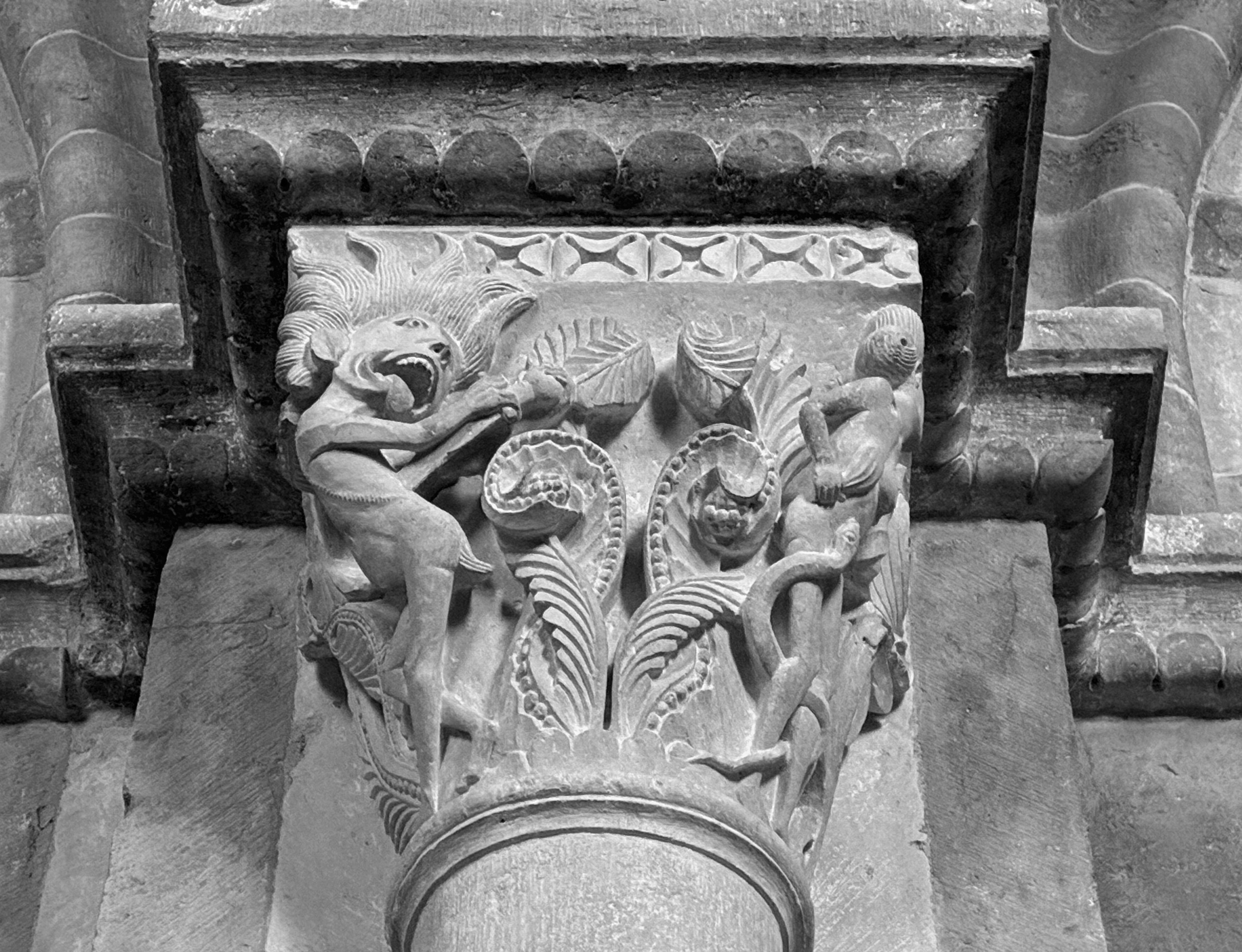
And a screaming demon with flaming hair
Carved in stone, in an act of self-slaughter,
Stabs itself in the back with a savage gesture
Warning of betrayal and the sin of despair.
Tonight, another woman will be raped,
Another child will never come home again,
Brought too soon to the final judgement
That awaits us under the tympanum.
But over the door to the writer’s house,
Haloed by the glow from a lone street light,
A swift makes its nest through the sapphire night
In a crack between broken masonry.
What cleft in the world could I call a home
If not in the defence of Europe’s walls?
How, across the pages of this ruin,
Should I rebuild my conquered country?
III
The defeated Germans, whose engineers
Set explosive charges in its pillars,
Cleared the rubble from the roofless ruin
Of the Basilica of St. Quentin.
Half as lucky was the Second Lieutenant
2nd Bn. Manchester Regt.
Who after the Butcher’s spring offensive
Was shell-shocked to find himself a poet.
Four decades would pass, and another war,
For the rebuilt church to reopen its doors
To France’s willing disarmament
By the European Parliament.
But fly now through the radiant chapels
Pied with the beauty of summer’s dapple
And the blue of heaven illuminates
Renaissance frescoes of Christian saints.
IV
Where angels look down from the flying buttresses
Of the Cathedral of Our-Lady of Reims,
The surplus labour of ten generations
Has been carved into statues of saints and sovereigns
Who condemned bonded serfs behind the rood screen
With the devil that led them in chains to damnation.
The departure lounge of our Civilisation
Is a brasserie on the Place Drouet d’Erlon
Served by slaves who, as in the last days of Rome,
Are waiting impatiently to slit our white throats:
Mamluk waiters, Moorish jugglers, Nubian rapists,
Breeders for the Caliphate, Saracen assassins.
We took the photograph but missed the experience,
Sitting in the dark, staring at the rose window
That glows between the gargoyles on the west façade;
While outside in the sun, Deliveroo Riders
Dress like American basketball players,
Their mouths flowing with the revenge of history.
In the morning, the hotel window faces east,
Shaded by shutters and a double row of curtains,
But the rising sun throws tomorrow on our closed eyes,
Casting inverted images in the darkened room:
The continent of Europe without Europeans,
Pilgrims to a cathedral that lies in ruins.
— London/Vézelay/St. Quentin/Reims, July-August 2025

I
The first line of the last stanza of this section is a reference to a line in the prose poem, ‘Matinée d’ivresse’, in Rimbaud’s Illuminations (1873-75): ‘Voici le temps d’assassins’. The final line is a reference to the title of Francisco de Goya’s aquatint, ‘El sueño de la razón produce monstruos’, from the album Los caprichos (1799).
II
The writer in the first stanza whose grave I visited in the cemetery of the Basilica of Vézelay is Georges Bataille, about whom I wrote my doctorate and, later, my first (privately published) book, The Colour of the Sacred: Georges Bataille and the Image of Sacrifice (2007). Bataille first moved to the town of Vézelay in the Spring of 1943 and returned to live there for four years after the Second World War. ‘The eternal hill [la colline éternelle]’ is the name for the teardrop-shaped hill on which the town is built. The quote is from the pages from Bataille’s L’Histoire de l’érotisme titled ‘Death’: ‘Un jour ce monde vivant pullulera dans ma bouche morte’. The final line of this stanza is a reference to a line in a poem by Emily Brontë, ‘Warning and Reply’ (1843), which Bataille quoted in the diary he kept during his first stay in Vézelay: ‘The time when my sunny hair / Shall with grass roots entwined be.’ It was to pay homage to Bataille that we visited Vézelay in the summer of 2025; but the town and basilica worked their magic on us.
On our month’s journey across France and Switzerland we visited eight churches: the Romanesque Basilica of Notre-Dame de Valère in Sion (1100-1265); the Romanesque Basilica of Saint-Marie-Magdalene in Vézelay (1120-1190); the Gothic Basilica of Saint-Quentin in Saint-Quentin (1170-1477); the Gothic Cathedral of Notre Dame de Reims in Reims (1211-1345); the late-Gothic Cathedral of Saint Francis of Sales in Chambéry (1420-1585); the Brutalist Chapel of Notre Dame du Haut in Ronchamps (1953-55); the Brutalist Convent of Saint-Marie de La Tourette (1956-1960); and the Brutalist Church of Saint-Nicolas in Hérémence (1968-71). The beauty and continuity between the architecture of these buildings, whose construction spans 860 years, the older of which were built on the sites of earlier (Merovingian or Carolingian) churches or Roman villas, and which have themselves been rebuilt, expanded and restored throughout the centuries, appeared to me as a metonym for European Civilisation.
The Roman villa that stood on the original site of the abbey in the village of St. Père had devolved to the Carolingian Count Girard de Roussillon, who founded a Benedictine convent there in 859. Within twenty years, however, this was dispersed by Moorish raiders from the Emirate of Córdoba, and a Benedictine monastery was established on the crown of the hill of Vézelay. Around 1050, Abbot Geoffroy claimed that the relics of St. Mary Magdalene had been brought to the abbey in 882 during the Saracen invasion of Provence. Their authenticity was confirmed by Pope Stephen IX in 1058, leading to the abbey becoming the start of one of the four pilgrim routes (Chemin de Vézelay) from France to Santiago de Compostela in Spain, which holds the relics of St. James the Greater that were discovered nearby in 814. Since 591, the sermon of Pope Gregory I has equated Mary Magdalene with a repentant prostitute (Luke 7:37); and when escaped or freed prisoners came to the abbey seeking redemption, Geoffroy had their chains melted down and reforged as iron railings around the church altar. Vézelay obtained the right of commune (to manage its own affairs and collect its own taxes) in 1060. However, Abbot Artaud, who taxed the peasants into rebellion for a new abbey church in order to capitalise on the influx of pilgrims, was killed in 1106. Raids by Muslim slave traders were launched on the coasts of Italy and France from the Eighth Century through to the Barbary Slave Trade under the Ottoman Empire that was only finally put to an end in the 1830s.
St. Bernard of Clairvaux preached the Second Crusade on the hill below the still unfinished church in 1146. Although defeated in Damascus, the crusade was successful in reconquering Lisbon and several other territories on the Iberian Peninsula. Vézelay was first fortified against invasion in 1150. Philip II and the newly-crowned Richard I (called the Lionheart) met in the abbey in 1190 before setting off on the Third Crusade, which failed to recapture Jerusalem from Saladin but did restore the Kingdom of Jerusalem. A frequent pilgrim to Vézelay, King Louis IX, who had been captured at the Battle of Fariskur during the Seventh Crusade and subsequently ransomed, visited the abbey in 1270 before setting off on the Eighth Crusade, on which he died. Known for both his piety and his prowess as a knight, Louis is the only French King to be canonised. The discovery in 1279 of another purported burial of Mary Magdalene in Provence challenged the authenticity of the relics at Vézelay, and from that time the status and wealth of the abbey declined.
The identification of the apostle James as Santiago Matamoros (St. James the Moor-slayer) dates from the Thirteenth Century, and refers to his appearance at the mythical Battle of Clavijo, which became a popular theme of the Christian struggle to reconquer the Iberian peninsula under Muslim rule (al-Andalus) between 722 and 1492. Though suppressed today in the official literature, the pilgrimage from Vézelay to the town of Santiago de Compostela, which had been sacked by the Caliph of Córdoba in 997, was to generate funds for the Reconquista. In contrast, after the 2004 train bombings in Madrid by Islamists that killed 193 people and injured around 2,500, it was proposed that the statue of Santiago Matamoros be removed from the Cathedral of Santiago de Compostela, one of the holiest pilgrimages of the Catholic Church. Fortunately, this act of appeasement of Muslim jihadists was stopped by public outrage.
On our last night in Vézelay we saw the Bach Ensemble of Amsterdam perform a concert of the choral works of Du Mont, Bach and Hayden in the nave of the basilica. The carved capitals of the columns in the nave are unlike anything I’ve seen elsewhere, except in the Romanesque remains in the basilica in Sion. Because it has an extended narthex, built in 1140-50 to accommodate the mass of pilgrims, the basilica has two central tympanum, the exterior one being a copy of an original that was destroyed during the French Revolution, and which shows the traditional scene of the Last Judgement. The interior tympanum, however, and the original entrance to the basilica, is unique in being a spiritual defence of the Crusades, and shows Christ sending the apostles to preach the Gospel.
When we visited the house in which Bataille lived in Vézelay there was, in fact, a swift’s nest under the lintel of its front door. This put me in mind of ‘The Stare’s Nest by My Window’ from W. B. Yeat’s ‘Meditations in Time of Civil War’ (1923), which contains the following stanza:
We are closed in, and the key is turned
On our uncertainty; somewhere
A man is killed, or a house burned,
Yet no clear fact to be discerned:
Come build in the empty house of the stare.
Yeats’ poem, as well as his ‘Nineteen Hundred and Nineteen’ (titled ‘Thoughts upon the Present State of the World’ when it was first published in 1921), provided me with a model and structure in which to write about the return of civil war to Europe a century later through its origins in the past. In the summer of 2025, predictions of a civil war breaking out in Britain were widespread in the UK. Some believed it already had.
In La Part maudite (1949), in the chapter titled ‘The Society of Conquest: Islam’, Bataille wrote: ‘How does one grasp the meaning of an institution that has outlived its reason for being? Islam is a discipline applied to a methodical effort of conquest.’
III
The French city of St. Quentin was occupied by the German Army in August 1914, and in 1916 became incorporated (along with Arras and Reims, which we also visited) into the Hindenburg Line on the Western Front. When the French Army retook the city in October 1918, they found that German engineers had bored 93 holes into the walls and pillars of the Basilica with the intention of demolishing what was left of the already greatly damaged structure. Fortunately, a French women, who had slept with the engineer captain tasked with detonating the charges, alerted the French Army to the plan.
The Second Lieutenant in the battalion which, in April 1917, as part of the disastrous Nivelle Offensive, attacked the Hindenburg Line at St. Quentin was Wilfred Owen. Knocked unconscious for several days by the blast of a mortar-shell, Owen was sent to the Craiglockhart War Hospital in Edinburgh, where he met the war-poet, Siegfried Sassoon, who confirmed his fellow poet’s calling. Owen’s poem, ‘Spring Offensive’, which he wrote the following year, was based on this experience. The commanding officer of the British Army on the Western Front was Field Marshal Douglas Haig, known as ‘Butcher Haig’ for his disregard for the lives of the two million British casualties under his command.
The restored Basilica of St. Quentin was only opened for worship in 1956, four years after the founding of the European Parliament and two years before that of the European Commission, whose members are bound by their oath of office to represent the interests of the European Union rather than that of their nation.
‘Pied Beauty’ is the title of a sonnet written by Gerard Manley Hopkins in 1877 but only published in 1918, in the last year of the Great War. It opens with the line: ‘Glory be to God for dappled things’.
Le Bleu du ciel is the title of a book written by Georges Bataille in 1935 but only published, after the Second World War, in 1957.
In the side chapels of St. Quentin are several frescos in poor condition but of high artistic quality, including an early sixteenth-century depiction of the life of St. Mary Magdalene and a seventeenth-century diptych of the nativity of Christ.
IV
The 2,303 statues in Notre-Dame de Reims, the most of any Gothic cathedral in France, includes the gallery of kings that runs across the west façade and around the two towers. This indicates the church’s status, ever since Clovis I, King of the Franks, was baptised on the site in c. 496, as the location for the coronation of the kings of France. In the tympanum of the left portal in the north transept is a bas-relief of the Final Judgement in which a devil draws a chained line of the damned to a cauldron on a burning fire. In 1914 the roof was set on fire by German shellfire, and the melted lead flowed through the mouths of the stone gargoyles. As I always am when I enter these monuments to the great thieves who, to this day, hide their money bags under their cassocks, when we visited in July 2025 I was torn between awe at the architectural magnificence of the thirteenth-century Gothic cathedral and horror at the level of expenditure it took out of the mouths and minds of the serfs whose bonded labour paid for it.
Georges Bataille spent his childhood in Reims between 1900 and 1914. In September of that year the city was engulfed by the war, and Bataille fled with his mother and elder brother. But in the summer of 1918, while training to be a seminarian (tuberculosis had exempted him from the army), Bataille published a short text titled ‘Notre-Dame de Rheims’ (sic), in which he recounted the fate of the cathedral.
Place Drouet d’Erlon is named after the French general and native of Reims who, 210 years earlier, in 1815, led the 1ere Corps of the Armée du Nord to defeat at the Battle of Waterloo. Mamluks (Turks enslaved by the Arabs), Moors (from North Africa) and Saracens (Arabs) were names used in medieval Europe to refer to Muslims. Nubians came from what today is Southern Egypt and Northern Sudan, which were conquered by Islam, respectively, in the Seventh and Eighth Centuries.
The opening of the third stanza is a reference to a line from T. S. Eliot’s ‘The Dry Salvages’ (1941), the third poem in his Four Quartets: ‘We had the experience but missed the meaning’. Today, the instrument of missed experience, and with it of any meaning, is the smartphone. The original camera was the camera obscura, the Latin for ‘dark chamber’.
Deliveroo, the British online food delivery company, is representative of the multinationals that employ hundreds of thousands of economic immigrants to Europe from sub-Saharan Africa, the Middle East and the Indian subcontinent, who remain, however, officially self-employed. In 2023, a spot check by the UK Home Office found that 42 percent of riders for Deliveroo, Uber Eats and Just Eat were working in Britain illegally.
This poem was written in the context of the threat to European Civilisation presented by the United Nations policy of replacement immigration, about which I have published a book, The Great Replacement: Conspiracy Theory or Immigration Policy?, which analyses its economic motivations, demographic justification, corporate lobbying, ideological promotion, political implementation, legal enforcement and financial, political and social impacts. Denounced by the UN as a ‘conspiracy theory’, this policy has settled 3.75 million immigrants from non-EU countries in the UK alone over the last decade, and similar if not greater numbers in France, Germany, Italy, Spain and other countries in Western Europe. My poem views this invasion through the lens of the Middle Ages and what we have been assured by the implementors of this immigration policy is the no longer relevant but, in reality, ongoing historical struggle for Europe between Islam and Christianity.
 Simon Elmer


Dear Simon, I’m Alix From Cybirdy Publishing. I have been reading your work with interest over the past few years. This piece is beautiful. Cybirdy would be interested to publish an anthology of this kind of poetry. If interested to start the conversation, give me a call on 0787 295 2660 Have a good end of the day, and keep writing for the good of the society! Alix
LikeLiked by 1 person
Hello Alix, thank you for writing to me. Yes, I would be interested. That phone number looks like it’s in Puerto Rico. Could you write to me instead? My email is: info@architectsforsocialhousing. Best wishes, Simon
LikeLike