Once every hundred centuries
He slithers from his mountain lair
In a hauberk of silvered scales,
Ridged back, snaggle-toothed, ice-blue glare,
Crawling turquoise down the valley,
Clinging with chameleon claws,
Saliva dripped in frozen drools.
Everything in his path, even
The sun in the indigo sky,
Has been slowed to the time of myth
That’s written in the creeping ice
By the grit of ten millennia
Encrusted on his belly with
The words of a million bards.
Nothing here has escaped the scars
Of his prowling through the ages:
Not the burnished cliffs by his sides
Or the moraine crushed by his rages,
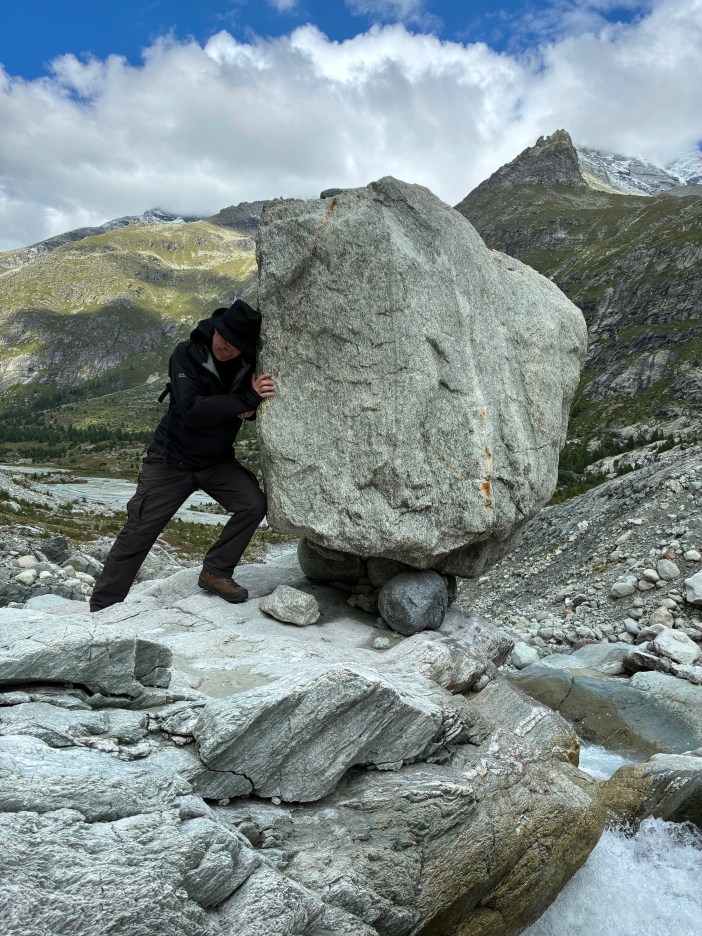
Nor the boulders left to balance
Beside the tongue of stream that leaps
From beneath his mantle of snow.
A monstrous wave frozen in time
To the pace of a continent,
When ancient man stared in wonder
At the never-ending torrent
Of two-million years of rainfall
That flows today, and will tomorrow,
From the jaws of the mountain god.
— Mont Miné Glacier, July 2025
• • • • •

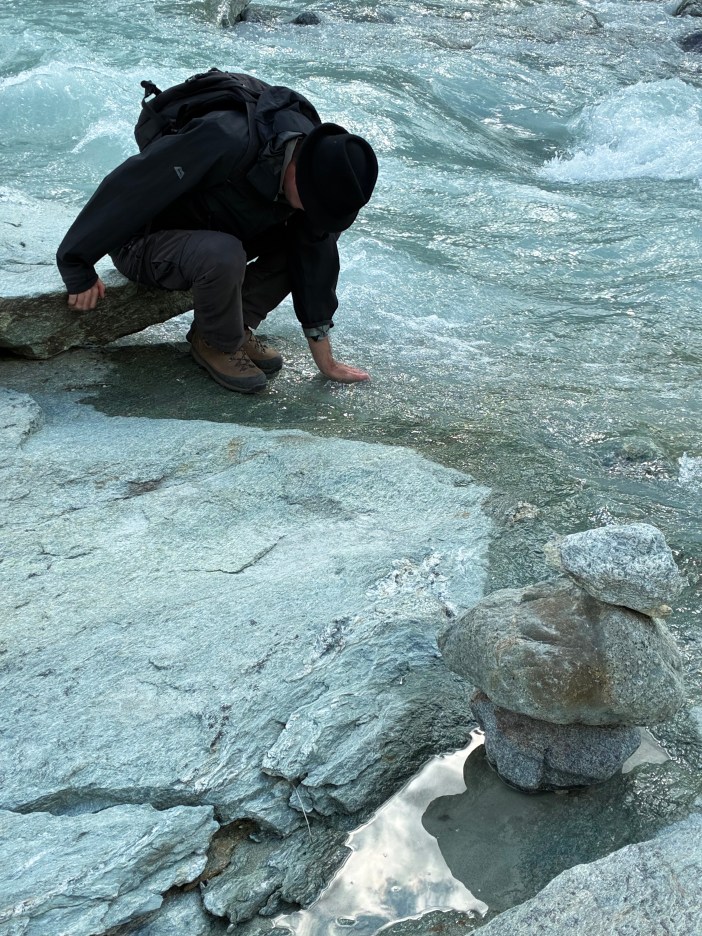
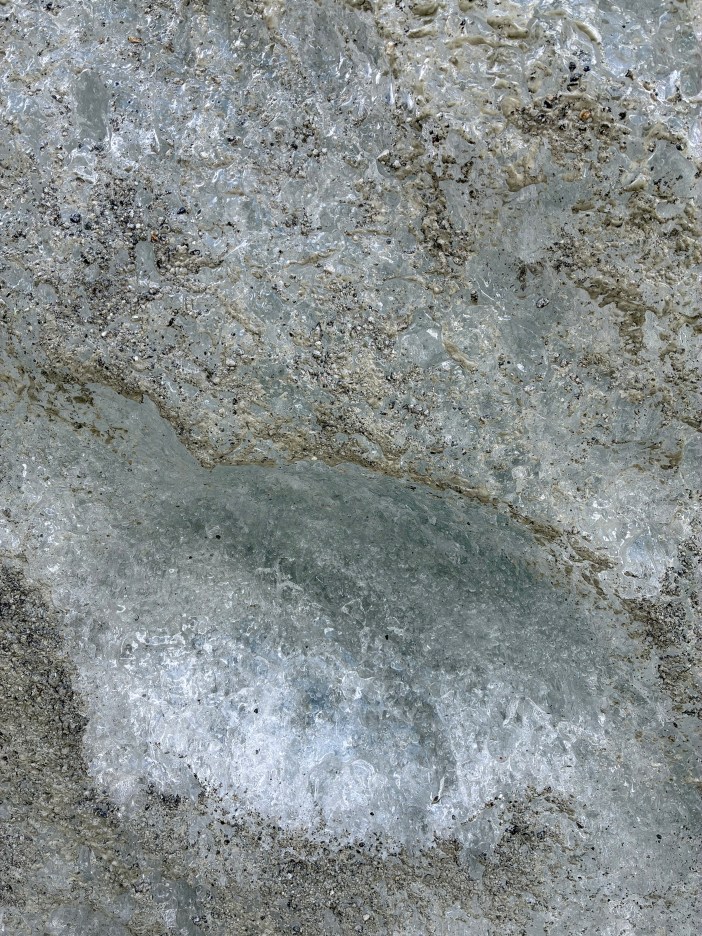
Although I had seen photographs and footage of glaciers before, my journey in Switzerland was the first time I had seen one with my own eyes. We reached the Mont Miné Glacier on a hike from the settlement of Ferpècle in the upper reaches of the Val d’Hérens, and to my surprise were able to touch its lowest walls, which were clear as ice though filled with grit from the valley floor.
Until the Nineteenth Century, the Mont Miné Glacier was joined with the Ferpècle Glacier in the neighbouring valley, which we also visited. First formed around 2 million years ago, the glacier advanced down the valley around 6,175 B.C. during a period of abrupt cooling in the otherwise warm period of the Early Holocene, and again between 1260 and 1380 A.D. at the beginning of the Little Ice Age that lasted, with intermittent warm periods, between 1300 and 1850 in Europe, following which we entered the current period of global warming. The evidence of these periodic and irregular changes are part of the suppressed proofs that the temperature of the globe is determined by the activity of the sun, the orbit of the earth around it and the movement of tectonic plates across our planet, rather than being caused by man-made emissions of carbon dioxide since the Industrial Revolution of 1750.

 Simon Elmer
Ice Dragon, another great piece of poetry to read on a December’s day. Thank you so much, you made my day. So, I could not resist. Here my instinctual translation of the last stanza in my mother tongue:
Une vague monstrueuse glacée dans le temps
Au pas d’un continent,
Au moment où l’homme d’autrefois le regard fixe
Émerveillé par le torrent sans fin
Fait de pluies de deux millions d’années
Demain ne cessera de couler, de même qu’aujourd’hui,
Des machoires de la déesse Montagne.
LikeLiked by 1 person
Chère Alix, quelle traduction formidable! I like the way you brought ‘Émerveillé’ around the corner of the line, as it were, to begin the next one. And ‘Demain ne cessera de couler, de même qu’aujourd’hui’ is a very inventive rendering of the English. It’s my day that you have made. Merci.
LikeLike
Great! I’m glad you liked it. Keep in touch, Alix
LikeLike
Reading again my translation which I did as the result of just enjoying reading your poem has something of avant-garde, extravagant and still mysterious to me. Translating the mountain god with La déesse montagne is very special indeed. The French classic cultural translation should be le dieu de la Montagne, isn’t?
LikeLike
French prepositions are a mystery to an Englishman. In English there’s a semantic difference between mountain god (which deifies the mountain) and god of the mountain (which indicates a deific relation to the mountain). But yes, despite la Dent blanche, the mountain which crowns Val d’Hérens, having a feminine noun, the vast mass of rock, ice and snow from which the unending torrent flows struck me very much as a male god.
As a translator of French poetry, you’ll notice that I’ve kept to Andre Breton’s injunction not to use the word ‘comme’ to form simple similes rather than (hopefully) poetic metaphors. I remember Dawn Ades, Breton’s translator, talking about this in her own translations. Thus, the grit of ten millenia is not ‘like’ the words of a million bards. The dripping ice is not like saliva. The leaping stream is not like a tongue. The covering of snow is not like a mantle. The creeping glacier is not like a dragon. And the mountain is not like a god. C’est un dieu!
Please excuse my self-indulgence, Alix, but it’s not often one gets to discuss poetics in today’s world!
LikeLike